

I used Claude Opus 4.6 to ghostwrite the first drafts of the articles in my Psychopathy sequence. That approach saved me some two days if the drafts turned out well compared to ones that didn’t turn out well, which I had to rewrite. In the grand scheme of things, this is a minor speedup, but if you have RSI, are not fluent in the language you’re writing in, or just dislike writing, it’s very helpful.
Research
Around February 2025, I started getting really excited about all the very different things that get lumped together under the label psychopathy. I had already been friends with someone who’s constitutionally psychopathic since 2015, but in the previous ten years, my interest didn’t go beyond riddling them with questions about their personal experience, without much engagement with the literature or other, very different presentations.
That changed in 2025, when I joined some Facebook groups to befriend people with narcissistic adaptations. It turned out a particularly psychopathic adaptation that I’ve named sovereignism is very common there, perhaps because it is actually better seen as a particular niche narcissistic adaptation. It’s different in other Facebook groups.
I made about 30 new friends with very different presentations of psychopathy and always tried to understand them well enough to determine exactly in what ways my childhood or constitutional factors would’ve had to have been different for me to be like them. My own adaptations were very self-effacing and people-pleasing, so sovereignism was simultaneously similar and opposite. That made it surprisingly easy for me to understand – to the extent this type of thing is possible – what it feels like to be them. Naturally, with my own adaptations so opposite, I could also learn a lot from them.
I augmented that with various books and podcasts, some of which I can recommend.
“Confessions of a Sociopath” by M.E. Thomas alias Jamie is very insightful
A drawback is that today she endorses very little of what she wrote in 2012/13 and has much better insight
Her YouTube channel M.E. Thomas where she hosts countless exciting and insightful interviews – highly recommended
Probably the best source for learning more about all forms of psychopathy (fun fact: Jamie is type D-anatta and her partner is type D-sovereign, so she’s an expert on the differences between those)
Nancy McWilliams’s seminal work Psychoanalytic Diagnosis – highly recommended
A comprehensive and impressive tour de force of psychology – required reading for anyone in psychology that also touches on various more psychopathic presentations
Papers by Dr. Abigail Marsh and her book The Fear Factor, which focuses very much on the N-hypoactive type
The book in particular has the drawback that their recruitment approach filtered somewhat for lower-functioning participants
The whole oeuvre of Lydia Benecke, who unfortunately is focused on criminal psychology, but is otherwise insightful
Trying to learn about psychopathy from prisoners is like trying to learn about entrepreneurship from people in bankruptcy court – who even came up with that idea? – but her special interest is crime, not psychopathy, so I can’t fault her on that
Daniel Ingram’s Mastering the Core Teachings of the Buddha
Which was surprisingly elucidating of various personality disorders and forms of psychopathy when you know what to look for
Psychopathy: Antisocial, Criminal, and Violent Behaviors edited by Theodore Millon – not recommended
A mixed bag with some mildly interesting chapters (including those authored by Millon himself) but also some of the most obviously shoddy research I’ve seen in a while that makes me wonder why a luminary like Theodore Millon would include it
Edward Bunker’s memoir Mr Blue: Memoirs of a Renegade
Interesting when you read it from the perspective of how he thinks, feels, and acts differently from how you might think, feel, and act in similar situations
James Fallon’s The Psychopath Inside
Interesting the same way Mr Blue is interesting plus for its neuroscience
Paul Bloom’s Against Empathy
Assorted papers, articles, lectures, interviews, etc.
That said, my personal conversations were greatly more useful to build an understanding of all the different adaptations and neurotypes that have been called “psychopathy” than any of the literature.
Veterinarians wouldn’t think that for treatment purposes it makes sense to lump together a spider and two cats in the same category because they have the same number of legs, but psychology researchers do the same regularly when they describe almost opposite presentations as “psychopathy.” Add to that the extreme selection effects that you get when you conduct your research at a prison or by recruiting kids with (de facto) conduct disorder, and the picture gets hopelessly confusing.
The only thing that helps at this point is to disaggregate, get to know the individuals, and then come up with a completely new way of conceptualizing the whole space.
Progression
My personal progression can be seen in my interviews with Jamie from April and June 2025, from how I describe sovereignism in my narcissism sequence from September 2025, and from my interviews with Tiffany from November 2025.
Ghostwriting
Over the months, I had many conversations with Claude to grapple with contradictions in my observations and to see whether there is existing research on phenomena that I’ve observed. Claude also came up with the classification scheme where I prefix letters like N (neurological) or D (psychodynamic) to certain features to clarify the intended abstraction layers.
Eventually, I felt like Claude had a solid grasp on my mental models and the personalities of my friends, and I instructed it to draft the article sequence.
The degree to which I had to edit or rewrite the articles varied widely. The introductory article is quite trivial, the genetic research is far outside my areas of expertise, and the neurological research suffers only from problems with bad diagnostic categories that it inherits from psychology, so it was four articles in that I had to start to make substantial edits to the texts.
You can see the diff here. The changes to articles 1–3 are fairly trivial, with only a few substantial manual additions. Articles 4, 6, and 7, I had to substantially rewrite, and article 5 fell somewhere in between with a number of substantial additions but also much text that I could keep. My changes to articles 6 and 7 are so substantial that the diffing algorithm couldn’t find the similarities anymore, but that is more reflective of article 7, which is actually almost completely manual, than article 6, because while it is substantially manual, I also had to rearrange many of the sections, confusing the algorithm.
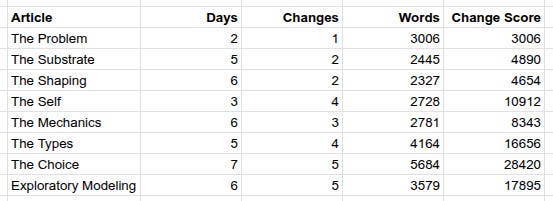
For good measure, I added my article “Tactical and Operational Exploratory Modeling for AI Governance” into the mix, which is fully manually written.
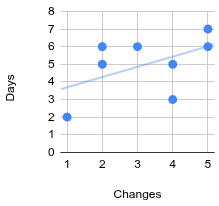
The x axis is a measure for how substantial my changes were – from 1, minor changes, to 5, virtually all rewritten. The y axis is the number of days on which I worked on the article before publishing it. I excluded days on which I didn’t work on them at all, but I didn’t track the particular hours per day. I hope particularly lazy or intense days cancel out.
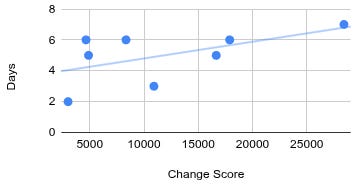
I also came up with a change score – the product of the word count of the article and the 1–5 rating above – to account for the fact that shorter articles are quicker to write.
Conclusion
In both cases the trend line indicates that with successful ghostwriting, I should expect to work some 4 days on the article, and without it, I should expect to work some 6 days on it.
Considering that the research process that allows me to form these mental models in the first place is one that takes 10 months, this difference of 2 days per article is vanishingly small. But I do dislike typing, and my conversations with Claude have helped clarify my thinking, so the time savings are not the only benefit of AI ghostwriting. Others might dislike the whole process of writing or find it difficult because they’re not fluent in the language they write in. I see much promise in AI ghostwriting.
Some readers have commented that they don’t like the particular writing style of some AIs. I wonder whether paradoxically AI ghostwriting might actually increase the demand for human ghostwriting: first get all the ideas written up by the AI, and then give the gpuscript to a human ghostwriter to rephrase into their uniquely human style.
What style do you like more, Claude’s from “The Problem,” or my own from “The Choice” or “Tactical and Operational Exploratory Modeling for AI Governance”?