

Introduction
In my article “Narcissism, Echoism, and Sovereignism: A 4-D Model of Personality,” I describe narcissism, echoism, and sovereignism in terms of values that the person tries to perfect like their life depends on it, because that’s what it actually feels like. (The fourth dimension is the severity of the personality pathology based on Kernberg’s levels of personality organization.)

Echoism:
General values: modesty, service, piety, purity, loyalty
Grandiose values: moral excellence, altruism
Vulnerable values: selflessness, sacrifice, invisibility, martyrdom
Narcissism:
General values: dignity, self-sufficiency, selectivity
Grandiose values: success, achievement, admiration, status, wealth, beauty, enlightenment, intelligence, excellence, prestige, sophistication, legacy, uniqueness, exceptionalism
Vulnerable values: insight, reserve, sanctuary, integrity, boundaries, solitude, nonconformity
Sovereignism:
General values: self-control, self-sufficiency
Grandiose values: power, control, domination
Vulnerable values: invulnerability (defense against hurt), impregnability (defense against intrusion), sanctuary, stoicism
The key finding of my article is that echoism and narcissism/sovereignism are not opposites but correlated dimensions: The same person can be echoistic in one context and sovereign in another.
But what determines which side they show? After all, someone who functions at the level of a personality disorder (the borderline to psychotic levels of personality organization) will have some degree of identity diffusion and won’t simultaneously have access to all their parts.
I think this is fundamentally about the attachment style that the particular relationship or situation brings out in the person.
Pathological Narcissism and Attachment
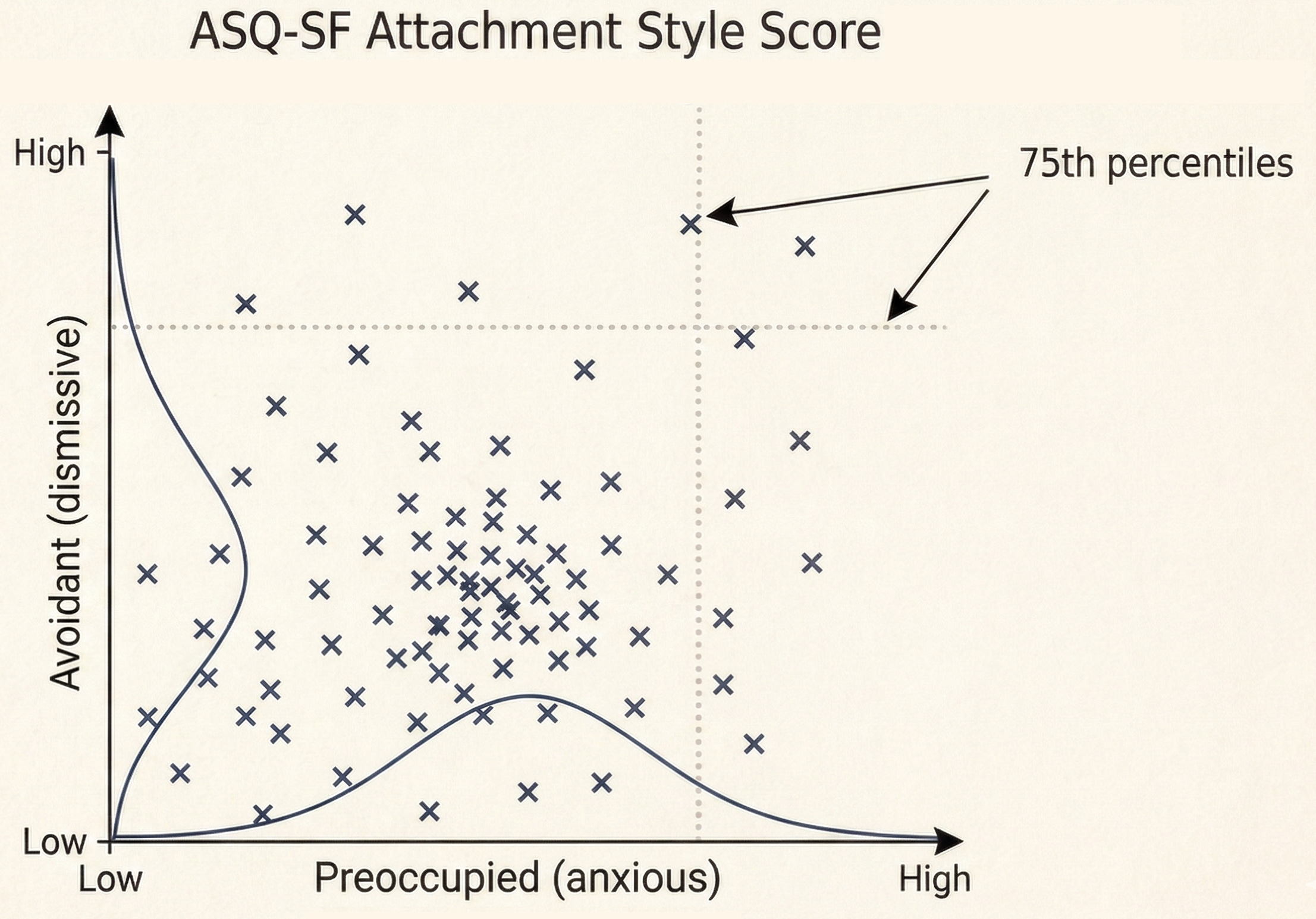
As I discussed in my interview with Dr. Mark Ettensohn, it’s critical for understanding attachment that we don’t think about it categorically but dimensionally: Attachment is normally distributed on both axes with most of the population, the moderately insecure majority, clustered around the median – a moderate degree of attachment preoccupation and avoidance. The boundaries to nominally insecure attachment at the 75th percentile are arbitrary cutoffs.
Different relationships and social situations bring out different attachment styles, but everyone has some very rough general tendencies.
Let’s look at the three data points to the top right.
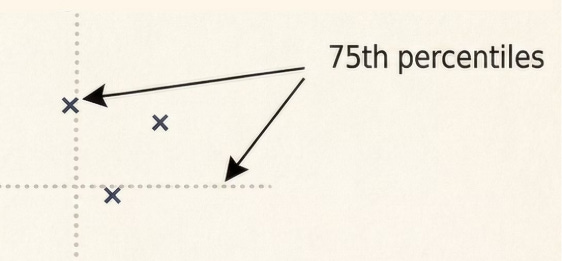
All of them have very high attachment preoccupation and avoidance, but there are slight differences between them.
My prediction is that if these people are personality disordered and have a narcissistic style, the one who is higher on avoidance than preoccupation will mostly cope through sovereignism; the one who is higher on preoccupation than avoidance will mostly cope with echoism; and the one who is well balanced will show a balanced mix.
In my experience, there’s a nonlinear relationship here where (say) a slight preference for avoidance has an outsized effect on how often they prefer avoidance across all the situations they find themselves in.
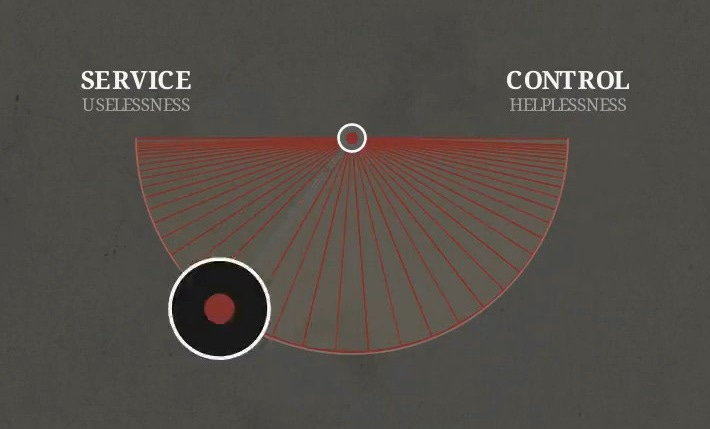
You can imagine it like a spectrum with echoism on one end and sovereignism on the other. The average person with pathological narcissism will move between the extremes depending on the situation, but some will spend most of the time close to just one or the other extreme.
So how does this interaction of attachment with echoism and sovereignism work on the gears level?
What characterizes the attachment styles is how a person feels about themselves vs. others. Preoccupied attachment is characterized by feeling bad about oneself but admiring others; avoidant attachment is characterized by feeling good about oneself but distrusting others.
A situation in which your social safety is improved by sycophancy will bring out the preoccupied and echoistic side:
Perhaps your academic career depends on the whims of a professor who is known for his fatalistic ideas of cultural evolution.
You come in highly motivated to reshape society in your leftist image.
Your hope clashes with the professor’s opinion that no individual can predictably influence the trajectory of cultural evolution because of the vagaries of dynamical systems.
You automatically adopt the professor’s opinions, become his favorite disciple, and write papers in his name on how people who want to change systemic issues have no idea what systems are.
But a situation in which your social safety is improved by dismissiveness will bring out the avoidant and sovereign side:
A friend from your Marxist reading group decides to spontaneously stop by your university department to say hi.
You decide they must’ve thought they could embarrass you in front of the professor, but you will not allow it.
You shout at them to piss off and never dare talk to you again.
In these situations it’s clear what attachment style you need to go for to protect yourself.
This gets more tricky when you have a crush on your Marxist friend. While you’re at the professor’s department, you can tell yourself that you only joined the Marxist reading group because your crush was part of it (whereas really they joined after you), not because of the Marxism. You tell yourself that you’re just tricking them by pretending to be a Marxist.
But when you’re at the Marxist reading group, your professor is far away and you actually become much more of a Marxist. In fact, you feel like you’re the purest Marxist of the whole group, and your crush is the only one of them who could possibly understand how far you outclass the others in your Marxism. After all, from their superficial perspective it’s hard to fathom just how deep your Marxist wisdom goes.
You want the validation from your crush, but they’re not so ineluctably your elder that your idealization of them could trump your idealization of your professor, so you have to split on your crush depending on your social context.
Echoist and Sovereign Etiologies
The relative propensity for different attachment styles also tells a story of the etiology of the personality style – how it formed in childhood. In “The Sadism Spectrum and How to Access It,” I write:

John Bowlby (Attachment and Loss, Vol. I) describes the basis of attachment styles as reliable or unreliable caregiver behavior:
If the parent is nonthreatening and attentive, that results in secure attachment of the child.
If the child doesn’t get the care they need, they sound the alarm (e.g., crying) so the parent remembers them and returns. If that works to keep the child alive, it results in preoccupied attachment.
If it fails and the parent doesn’t return, the constant alarm might attract predators, so the child hunkers down and tries to survive for as long as possible, fearing to be eaten by predators at any moment in their hostile environment. That’s avoidant attachment.
If the parent is also the predator, that’s disorganized attachment.
Parental Projections
One etiology that I often see and that is also covered in Mentalization-Based Treatment for Pathological Narcissism is that of a parent who themselves suffers from pathological narcissism, has added the child to their identity, and so depends critically on how well the child performs in public and how that reflects on them. They can do this through a mix of self-deception and conditioning of the child.
For example, if the parent parades the kid around in front of friends and relatives and have the kid solve chess puzzles to show off their intelligence, but they get nervous and make an illegal move, the parent can pretend it didn’t happen and pray to God that it won’t. The panic that the parent shows in such a situation will teach the kid that making mistakes is absolutely unacceptable.
Or the parent can, behind the scenes, explicitly punish the kid for the mistake by telling them what an embarrassment they are for the parent, by having them solve more and more endgame puzzles, through silent treatment, timeouts, or some combination.
A child depends on what is called contingent marked mirroring to form its self in the first place. My theory is that children start out awakened, in the Vipassana sense, and only learn selfhood in the first two years of life. The parent teaches the child what experiences to consider their own (and take responsibility for them) and which to consider that of the parent or others. If the contingent aspect breaks down because the parent never actually sees the child (but just their projections), the child mistakes the parental projections for their own self.
Abuse of this type will tend to slant the kid in the direction of preoccupied attachment, at least in relationships where they find themselves in a child-like position.
The kid will feel fundamentally vile and seek to hide and compensate for their shamefulness.
Love Scarcity
Another etiology is common in families with a high child-to-parent ratio.
The parent doesn’t have enough attention for all children, but the children find that they can get a bit of love if they outcompete all their siblings. Perhaps they’ll even find their niches: One child who has a forte for being smarter than the others; one who has a forte for being more mischievous than the others; one has a forte for being more helpful than the others; etc.
The kids will feel fundamentally vile and seek to hide and compensate for their shamefulness by perfecting their compensatory skills.
Some get really good at it around puberty and can keep it up almost perfectly. But little slips in the perfection cause terrible narcissistic injuries because they make the perfection feel like pretense, and then the feeling of worthlessness shines through.
Parentification
More on the avoidant side, we have straightforward parentification, where the child is expected to care for the parent from early on, e.g., because of the parent’s drug addiction or personality disorder. First they have to manage the parent’s emotions; soon they have to manage their finances.
The child meanwhile feels perfectly neglected, being de facto without a parent, and develops high avoidant attachment. If the parent is just helpless without them, the child will learn that they are capable and others are useless; if the parent is moody and sometimes dangerous, they’ll learn to see others as threats.
In Psychoanalytic Diagnosis, Dr. Nancy McWilliams also mentions a particular form of reaction formation that is common when there’s a particular age gap between the children:
Perhaps the earliest age at which the process is easily discernible is in a child’s third or fourth year; by this time, if a new baby arrives, the displaced older sibling is likely to have enough ego strength to handle its anger and jealousy by converting them into a conscious feeling of love toward the newborn. It is typical of reaction formation that some of the disowned affect “leaks through” the defense, such that observers can sense there is something a bit excessive or false in the conscious emotional disposition. With a preschool girl who has been displaced by a younger brother, for instance, there may be a distinct flavor of her “loving the baby to death”: hugging him too hard, singing to him too loudly, bouncing him too aggressively, and so on. Most adult older siblings have been told a story about their pinching the new baby’s cheeks until the child screamed, or offering some delicacy that was actually poisonous, or committing some similar transgression that was allegedly motivated by love.
The older child is expected to take on a carer role for the child and deny their envy. The above is one way this can play out. But for an older child whose parent has added them to their identity, it’s more straightforward to add the younger child to their identity, recapitulating the transgressive relationship with their parent.
The upshot is the same, a child who feels strong and independent themselves but distrusts others.
Neglect
Besides those fancy forms of neglect, there is also straightforward neglect. In Nazi Germany it was elevated to the level of doctrine, perhaps because the resulting extreme avoidant attachment is the closest approximation of psychopathy that you can induce without genetic factors. I touch on possible explanations of this link in my article “Psychopathy: The Self.”

Sometimes a parent is incapacitated by depression or an accident or a single parent has to work all day and leave the child alone for lack of parenting support.
Or the parent has little understanding of emotions because of their own avoidant attachment, alexithymia, or psychopathy. The last two of these might be heritable, which overdetermines how the child will turn out.
Absent a parent, general life circumstances will do the parenting. Perhaps the child is clever and can find ways to exploit friends and relatives for some kind of materialistic ersatz of parental love. If they’re big rather than smart, violence can serve a similar purpose. Or they discover drugs and dangerous criminal adventures to fill the void.
Where the child with the countless siblings earns love by outcompeting the others, these children earn a kind of love ersatz to the extent to which they can extract it from their environment.
The result is the kind of emotional neglect that puts a child into a pure survival mode for the rest of their life. They’ll feel strong and independent themselves but will have no regard for other people.
Fetishes
Fetishes are an interesting case because they develop very early for children, usually long before puberty when personality disorders take their more or less final shape. They are sometimes present by age 3 or 5 already. A child can respond to having a fetish in one of two ways.
A child with a preoccupied style will fear the disapproval of others and hide that part of themselves to the best of their ability.
They start out with a strange diffuse feeling of badness, like they’re that ugly gift from an annoying relative that you keep in some box in the attic because it would feel disrespectful to throw it away – at least so long as the relative might still remember it.
With the fetish, that diffuse feeling becomes more concrete. They’re not diffusely bad because of some guilt from a past life, a demonic possession, or their inability to flawlessly anticipate all their parent’s expectations but because of this sordid fetish!
This will amplify the preoccupied need to hide behind a facade of pretend perfection.
Conversely, a child with an avoidant style may dislike the cognitive dissonance that the fetish gives them just as much as anyone else but resolve it by making it their identity, be it a secret identity. It’ll give them the feeling of specialness and pride that someone has who is the heir to a powerful secret. Their superiority is confirmed whenever they regard others and know they don’t even know what they don’t know. Perfectly ignorant sheeple.
That’s particularly interesting in the case of a sadism fetish that’ll make it easy for someone with avoidant attachment to see themselves in movie villains and construct a whole false self around the idea of being a supervillain. Every time they derive pleasure from the subjugation or exploitation of someone weaker, they’ll feel confirmed in their chosen identity. Prosocial parts of their identity must be denied or confabulated as mere pretense.
