

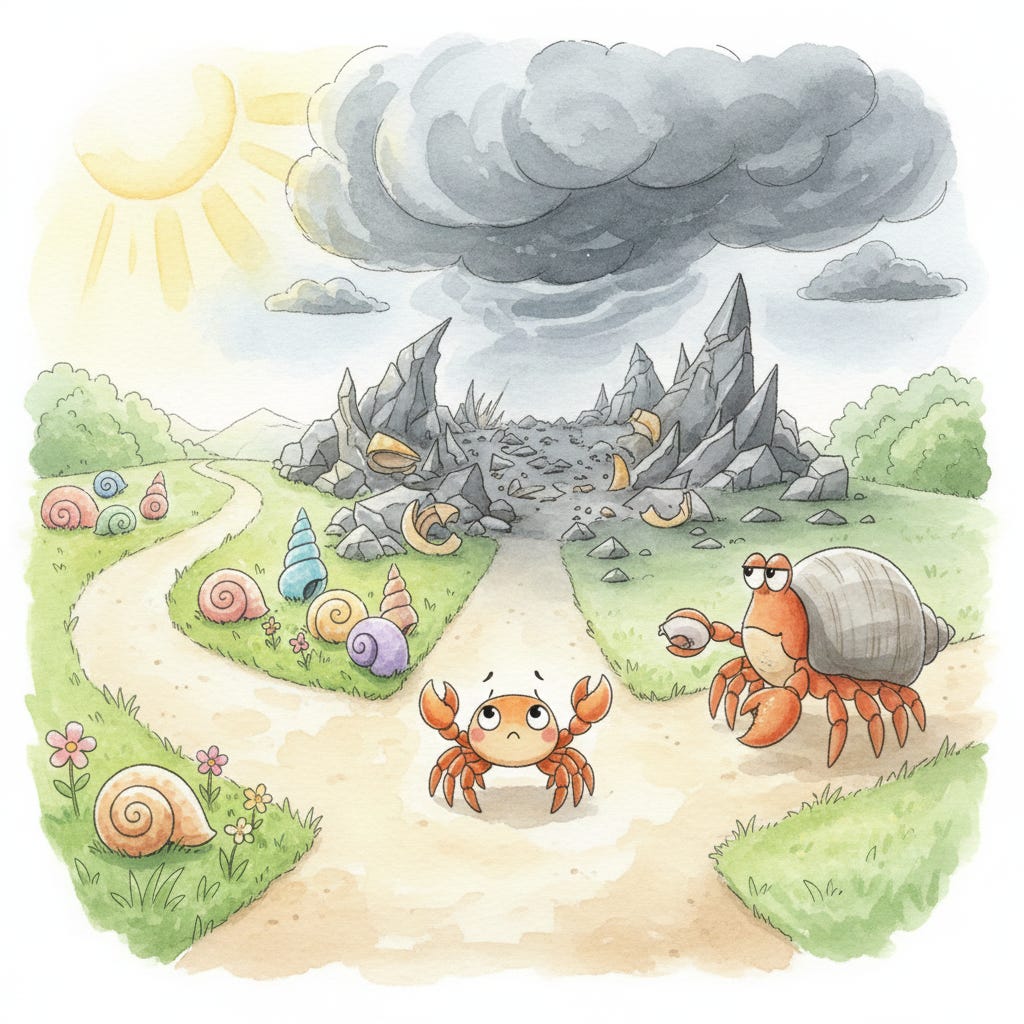
This is the third article in a series on understanding psychopathy. The first article introduced the framework; the second covered genetics and neurology. This article covers the E (environmental) level – what happened to you developmentally, and how it shaped your expression.


Introduction
Two people with identical genetic loading can turn out completely differently. One becomes a functional professional with stable relationships; the other becomes a violent criminal. The difference is often the environment – what happened during critical developmental periods.
But “environment matters” is too vague to be useful. This article develops a more precise picture: What kinds of environments lead to what kinds of outcomes? Why does controlling adversity produce different results than chaotic adversity? How do the pieces fit together?
The E-Level Framework
Tiffany suggested three periods, of which I’ve subdivided the first into infancy and childhood for four developmental periods total, each with its own features:

Each period can be characterized by the type of environment experienced. Different environments at different periods have different effects.
E-I: Infancy (0–2 Years)
The Critical Task: Attachment
The primary developmental task of infancy is forming an attachment to caregivers. This attachment becomes a template for later relationships – a model of whether others are trustworthy, whether the self is worthy of care, and how to regulate emotions.
Attachment Styles
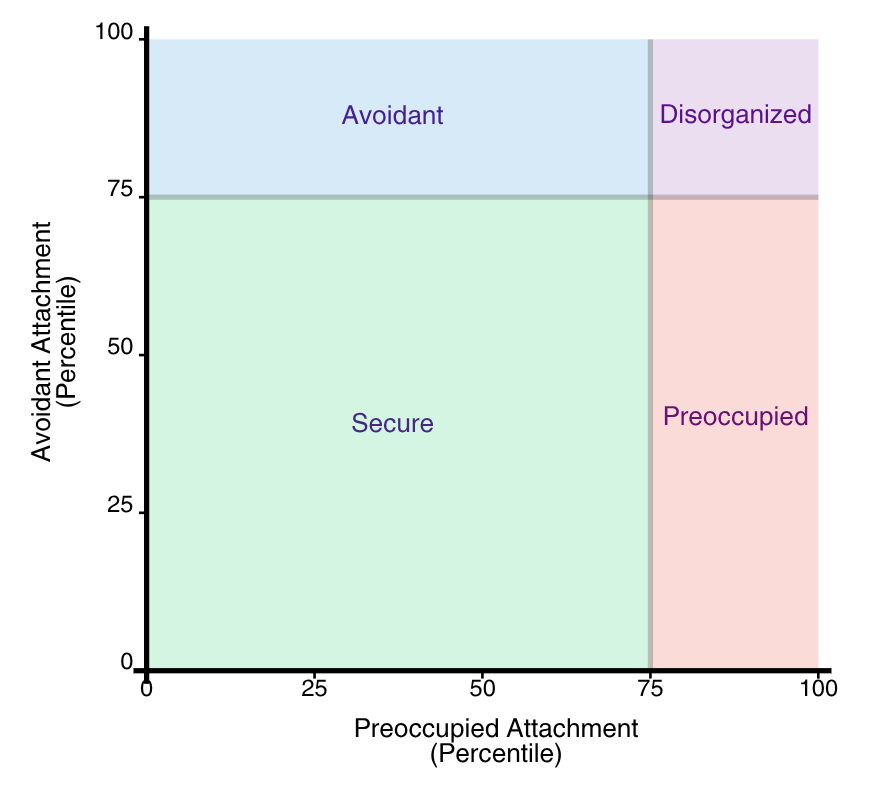
Mary Ainsworth’s research identified three organized attachment styles, and Mary Main later added a fourth:
Secure (E-I-secure). The caregiver is consistently responsive and attuned. The child learns that others are reliable and that distress can be regulated through connection. This is the foundation for healthy development.
Avoidant (E-I-avoidant). The caregiver is emotionally unavailable or rejecting. The child learns to suppress attachment needs and rely on self. Emotions are managed through distance and independence.
Preoccupied (E-I-preoccupied). The caregiver is inconsistently responsive – sometimes attuned, sometimes unavailable. The child becomes hyperactivated about attachment, constantly monitoring the caregiver’s availability. Emotions are amplified to try to elicit response.
Disorganized (E-I-disorganized). The caregiver is frightening or frightened – the source of both comfort and threat. The child faces an unsolvable dilemma: Approach the source of fear, or flee from the source of comfort? This produces contradictory, fragmented behavioral strategies.
Disorganized and Avoidant Attachment and Psychopathy
Disorganized and avoidant attachment are particularly relevant to psychopathy and related presentations. When the attachment figure is absent or irrelevant, the child will ignore them. When they are the source of fear, the child cannot develop a coherent strategy for managing distress in the first place. This can lead to:
Dissociative responses. The child learns to disconnect from overwhelming experience.
Controlling strategies. The child later develops either punitive-controlling (dominating the parent) or caregiving-controlling (parenting the parent) patterns.
Fragmented self-structure. The self develops in unintegrated pieces, without coherent organization.
Many of the sovereigns I know have histories consistent with disorganized or avoidant attachment – dangerous parents, early role confusion, and later controlling strategies. The tendency towards avoidant attachment that they show may often be the result of their NPD (in grandiose moods) rather than genuine avoidant attachment.
E-C: Childhood (2–12 Years)
The Critical Tasks: Moral Development, Socialization, Self-Concept
Childhood is when moral emotions develop, social skills are learned, and the self-concept takes shape. Disruptions during this period can have lasting effects on all three.
Types of Childhood Adversity
Not all adversity is the same. Different types of adversity produce different adaptations:
E-C-unattuned (unattuned mirroring). Non-contingent marked mirroring. The caregiver is present but doesn’t accurately reflect the child’s emotional states. The child’s feelings are met with non-contingent responses – the caregiver’s reactions don’t match what the child is experiencing, usually because they instead match expectations that the caregiver projects on the child. This disrupts the development of mentalization – the capacity to understand mental states in self and others.
This is the classic etiology for narcissistic pathology described by mentalization-based treatment (MBT) researchers. The child develops without an accurate internal model of their own mind, and must construct a “false self” to adapt to the caregiver’s projected expectations.
E-C-neglect (emotional neglect). The caregiver is physically present but emotionally absent. The child must fend for themselves emotionally – there’s no guidance, no attunement, no help regulating distress.
Children adapt to neglect in various ways:
Machiavellianism. Learning to get needs met through manipulation, since direct requests don’t work. The child practices attunement to needs that the environment can meet if they are extracted from it; the child represses needs that cannot be met that way. Control as surrogate for love. This can lead to the D-sovereign presentation.
Echoism. Learning to suppress all needs, since expressing them is ineffective or risks punishment. Needs can instead be met by making another dependent on your generosity. Dependency as surrogate for love. This leads to the D-echoist presentation.
Admiration-seeking. Learning to get needs met by seeking admiration as a substitute for love. If the parents are not forthcoming with love, this alternative can be won from peers, bosses, school authorities, or the public instead. This can lead to the D-narcissistic presentation.
E-C-punitive (punitive environment). The caregiver uses harsh, somewhat predictable punishments. Errors are severely penalized. The child learns that mistakes are dangerous.
This often produces Machiavellianism – learning to avoid punishment through deception, excuse-making, and blame-shifting. It can also produce severe shame and a preoccupation with not getting caught.
E-C-chaotic (violent/chaotic environment). The home environment is unpredictably violent. The child is exposed to domestic violence, physical abuse, or chaotic aggression. The difference to E-C-punitive is its unpredictability.
This often produces:
Hypervigilance. Constant scanning for danger.
Aggression. Learning to strike first.
Avoidant attachment. Learning that people are dangerous.
This is the pathway to the “hot” psychopathy pattern – the reactive, F2-heavy presentation associated with criminal behavior.
E-C-controlling (over-controlling). The caregiver excessively controls the child’s behavior, choices, and even thoughts. Autonomy is suppressed; the child’s agency is denied.
This often produces extreme autonomy preoccupation (what I call D-autonomic). The child who was never allowed to choose becomes an adult who cannot tolerate any constraint. This may manifest as:
Rage at perceived imposition. Any expectation feels like control.
Contractarian social model. Only explicit agreements count; implicit obligations are rejected.
Preemptive control. Controlling others to ensure one’s own autonomy.
E-C-parentified (parentification). The child is forced into a caregiving role – caring for a parent, for younger siblings, or for the household. Normal childhood is lost to premature responsibility.
This can produce:
Premature self-reliance. The child learns to depend only on themselves.
Caretaking identity. The self becomes organized around caring for others (a pathway to echoism).
Narcissistic features. If the parentification was combined with other narcissistic injuries.
E-C-golden (golden child). The child is treated as special, but conditionally – love depends on performance, appearance, or compliance. The child learns that their worth is contingent on meeting expectations.
This is a classic pathway to pathological narcissism. The child develops a false self to live up to all the expectations, but it’s fragile because it depends on external validation and disavows most of the child’s authentic self.
E-C-scapegoat (scapegoated). The child is blamed for family problems, devalued, and shamed. They’re the “bad one.”
This can produce pathological narcissism as the child tries to defend against core feelings of worthlessness. Or it may echoism if the child interprets the core shame as uselessness and tries to earn worth through selfless service.
E-C-normal (normal). None of the pathological properties appear to apply.
E-P: Puberty/Adolescence (12–18 Years)
The Critical Tasks: Identity, Peers, Autonomy
Adolescence is when identity consolidates, peer relationships become central, and autonomy from family develops. Disruptions during this period affect adult identity and social functioning.
Key Features
E-P-peer-success (Peer Success). Had friends, was socially accepted, experienced belonging.
This is stabilizing for grandiose structures. The narcissistic or sovereign adolescent who is popular has their grandiosity reinforced socially. This may produce a more stable presentation in adulthood.
E-P-peer-failure (Peer Rejection). Bullied, rejected, socially isolated.
This can produce shame-based presentations – pathological narcissism with a predominantly vulnerable expression, social anxiety, or withdrawal. For those with psychopathic substrate, it may intensify hostility toward the social world that rejected them.
E-P-antisocial (Antisocial Trajectory). Involved with delinquent peers, criminal activity, or gang involvement.
This is the pathway to F2-heavy adult presentations. Antisocial behavior is normalized; criminal skills are developed; prosocial paths close off.
E-P-identity-formed vs. E-P-identity-diffuse. Did identity consolidate or remain diffuse?
Those who consolidated an identity often struggle with its rigidity whereas those who don’t rather struggle to maintain any continuity in life. Those with diffuse identity may show D-anatta features – minimal coherent self, chameleon-like adaptation.
E-A: Adult Entry (18–25 Years)
The Critical Task: Establishing Adult Life
How did the person enter adult life? This period often crystallizes patterns that persist.
E-A-success (conventional success). Completed education, stable employment, relationships.
This provides structure and reinforcement for prosocial functioning. Even someone with significant psychopathic loading may function well if they entered adulthood successfully.
E-A-privilege (privilege). Inherited wealth, status, or connections.
This provides external structure regardless of internal development. The person may be highly dysfunctional internally while appearing successful externally.
E-A-crime (criminal pathway). Incarceration, criminal career.
This crystallizes antisocial patterns. Prison socializes further into criminal culture; criminal record closes off legitimate paths; the identity becomes “criminal.”
E-A-addiction (addiction pathway). Substance use as primary adaptation.
Addiction complicates everything. It may mask underlying presentations, worsen symptoms, or become the central organizing problem.
E-A-unstable (unstable/chaotic). Failed to establish stable adult life – unstable housing, employment, relationships.
This indicates ongoing dysfunction. Without stability, development of more mature functioning is difficult.
Developmental Narratives: Putting It Together
Let me illustrate how G, N, and E combine to produce different outcomes.
Narrative 1: The Lucky Primary
G-callous → N-hypoactive → E-I-secure → E-C-normal → E-P-success → E-A-success
This person was born with reduced empathy and fear (G-callous), which was expressed neurologically as constitutional amygdala hypoactivity (N-hypoactive). But they were raised by attuned, secure parents (E-I-secure) who provided structure and guidance (E-C-normal). They were socially successful in adolescence (E-P-success) and entered adulthood through conventional paths (E-A-success).
Outcome. Functional psychopathy. They have the substrate but not the pathology. They may be unusually calm, fearless, and emotionally detached, but they’ve developed values, regulation, and prosocial behavior. They probably don’t identify as having any disorder.
Narrative 2: The Street Primary
G-callous + G-impulsive → N-hypoactive → E-I-disorganized → E-C-chaotic → E-P-antisocial → E-A-crime
Same constitutional loading (G-callous), but combined with impulsivity (G-impulsive) and expressed in a chaotic, violent environment (E-I-disorganized, E-C-chaotic). They fell into antisocial peer groups (E-P-antisocial) and entered adulthood through criminal pathways (E-A-crime).
Outcome. Criminal psychopathy. F2-heavy, violent, incarcerated. The substrate was channeled into antisocial expression by the environment.
Narrative 3: The Primary Sovereign
G-callous → N-mixed (hypoactive + dissociative) → E-I-disorganized → E-C-controlling/E-C-parentified/E-C-neglect → E-P-peer-success → E-A-success
Constitutional callous loading, but the key factor is the type of adversity: Controlling, parentifying, rather than chaotic. The person developed sovereignty – a power-and-control orientation that combined grandiosity with callousness.
Outcome. Sovereignism. High-functioning but relationally damaging. Control-oriented, sadistic, autonomy-focused. Functions well by conventional measures but leaves destruction in personal relationships.
Narrative 4: The Secondary Sovereign
G-minimal → N-dissociative (was hyperactive) → E-I-disorganized → E-C-chaotic + E-C-controlling → E-P-peer-failure → E-A-variable
No particular genetic loading, but severe mixed adversity (both violent and controlling). Originally reactive (N-hyperactive), but chronic trauma led to dissociative dampening (N-dissociative). The person developed sovereign features defensively, but remembers being different as a child.
Outcome. Potentially reversible sovereignty. The key marker is memory of being different. This person is likely able to recover some emotional capacity with safety, attachment, and time.
The Environment Selects, Not Creates
An important framing: The environment doesn’t create psychopathy from nothing. Rather, the environment selects which genetic potentials get expressed.
Someone with G-callous loading has the potential for both functional and dysfunctional outcomes. A supportive environment selects for the functional expression; an adverse environment selects for the dysfunctional expression.
This is gene-environment interaction: The effect of genes depends on the environment; the effect of the environment depends on genes. Neither alone determines the outcome.
Tiffany in particular predicts that early neglect tends to lead to “empty” presentations – children who never form much of an identity and scour their social environment for surrogates of parental love through admiration or exploitation – whereas more actively abusive childhoods more likely produce children with harsh introjects – children who take on draconian expectations from their caregivers. Here it is important to distinguish between those who develop actual pathological narcissism vs. those who merely make use of grandiosity or “trait narcissism” because it’s useful in their environment but without any pathological narcissism.
Implications for Understanding
For self-understanding. Knowing your developmental history helps you understand why you developed as you did – not to excuse, but to explain. Understanding the pathway doesn’t change the endpoint, but it may change how you relate to it.
For clinicians. The type of adversity suggests the type of adaptation. Chaotic adversity → behavioral defense. Control adversity → self-structural defense. This has implications for treatment focus.
For prediction. E-level factors help predict outcomes. E-I-secure is protective; E-I-disorganized is a risk factor. E-A-success is stabilizing; E-A-crime is crystallizing.
Summary
E-I (infancy). Attachment formation. Secure, avoidant, preoccupied, or disorganized. Disorganized attachment is particularly associated with later psychopathy and sovereignty.
E-C (childhood). Moral development, socialization, self-concept. Key adversity types: Unattuned, neglect, punitive, violent, controlling, parentified, golden, scapegoat. The type of adversity predicts the type of adaptation.
E-P (puberty). Identity, peers, autonomy. Peer success vs. failure; antisocial trajectory; identity consolidation vs. diffusion.
E-A (adult entry). Pathway into adult life. Success, privilege, crime, addiction, instability.
Next: The Self
The next article explores the D level – how the biological substrate and environmental shaping produce particular psychological structures. What are the different ways the psychopathic self can be organized? What is sovereignty, and how does it differ from standard narcissism?
