Attachment Style Questionnaire Short Form (ASQ-SF)
Attachment styles (see below) are something that I consider fundamental to the personality of any human and possibly many other mammals. They also have a great influence on how personality disorders present. You can read more about them in the glossary below and in the chapter on attachment.
The ASQ-SF scores you on two dimensions of attachment – preoccupied (alias anxious) and avoidant (alias dismissive) – and a few subscales. The subscales of preoccupied attachment are “preoccupation with relationships” and “need for approval.” The subscales of avoidant attachments are “discomfort with closeness” and “relationships as secondary.” Both of the major subscales are mitigated by items from another subscale “confidence in interpersonal interactions.” For example, if someone scores high on “It’s important to me that others like me” but also high on “I am confident that other people will like and respect me,” the effect on the assessment of their preoccupied attachment will be mitigated.
You can test out whether your scores change depending on what relationships you have in mind while answering the questions.
Attachment Styles
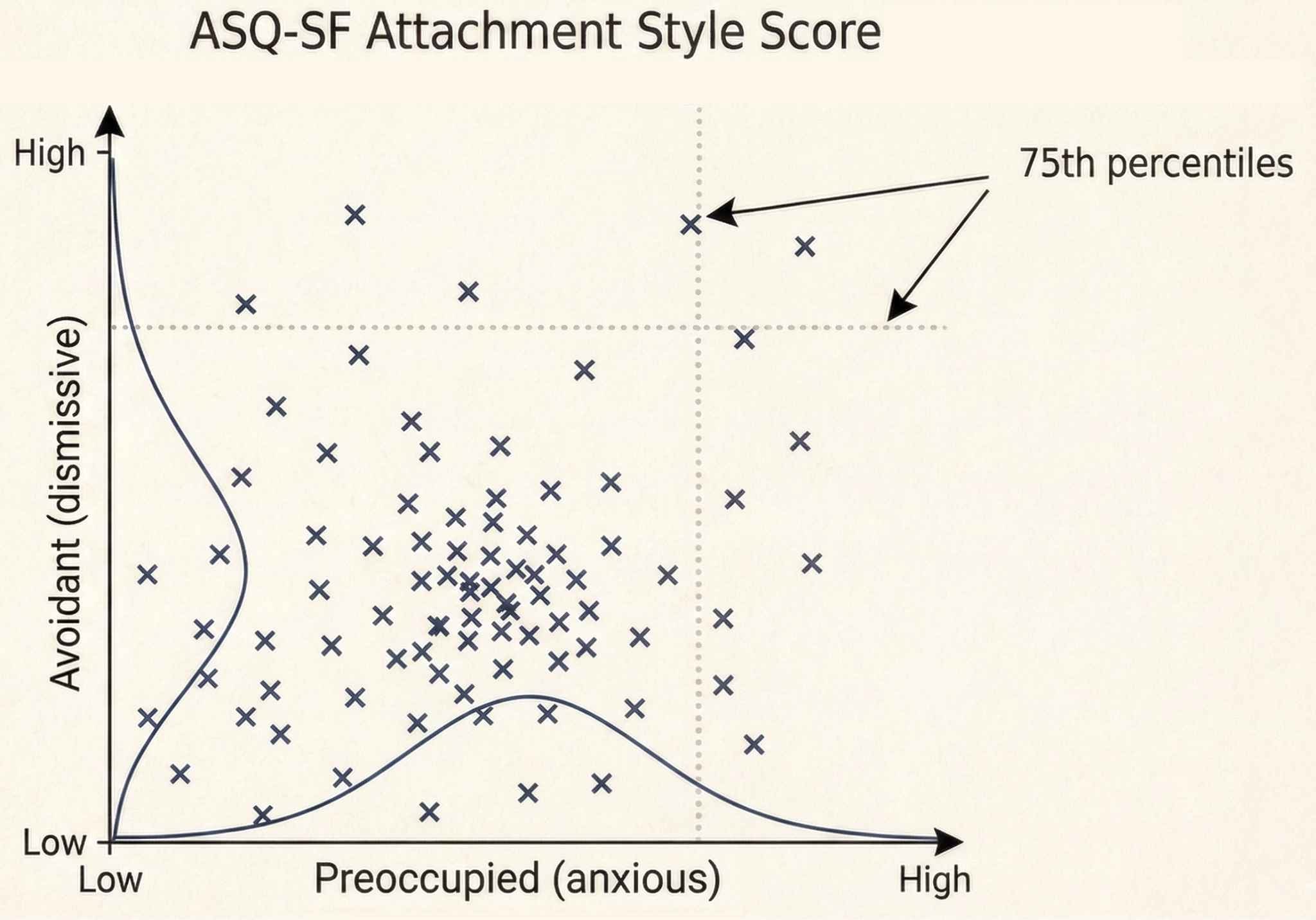
Attachment styles are often thought of as categorical: secure, preoccupied (alias anxious), avoidant (alias dismissive), and disorganized (alias fearful-avoidant). But that’s a red herring. Really there are two dimensions – attachment preoccupation and avoidance – which are even slightly correlated.
A lucky few are very low on both and are truly secure. Most people are medium-high on both and still officially count as secure, but there’s room for improvement. People who’ve suffered rather unreliable parenting will usually score high on preoccupied attachment. They feel weak, dependent, or unworthy and admire others as strong, reliable providers. People who’ve suffered neglectful parenting will score high on avoidant attachment. They feel independent or unflappable and distrust others because they seem unreliable or threatening.
If these styles exceed the 75th percentile (i.e. the score is higher than that of 75% of the population), it’s categorically considered preoccupied or avoidant respectively.
People who suffered more active abuse often score above the 75th percentile on both dimensions, which is considered disorganized attachment, i.e. the lack of a consistent attachment style.
Everything that is not secure attachment is considered insecure attachment. Categorically that again uses the 75th percentile cutoff, but in reality it’s a gradient. Insecure attachment is a risk factor for personality disorders.
Core Shame
The name core shame is another red herring because it virtually never feels like shame. In The Gifts of Imperfection, Brené Brown writes that it is “the intensely painful feeling or experience of believing that we are flawed and therefore unworthy of love, belonging, and connection.” And that it convinces us “that owning our stories will lead to people thinking less of us. Shame is all about fear.”
That sucks, so we deny it. That’s how core shame really shows up: in our contortions to deny it. Core shame is deeply ingrained from childhood, so its denial takes constant upkeep.
One straightforward way to deny it is to preemptively stop caring about everyone else, an avoidant strategy. You don’t care whether anyone considers you unworthy of love, belonging, and connection if everyone is dead to you or an enemy.
Another one is to make sure that everyone else is just as unworthy as you are or more so, because they won’t throw bricks when they live in a glass house.
A third one is to take a lot of performance-enhancing drugs, so you’re always on top of everything and can reliably fool everyone into thinking you’re actually worthy (spoiler: you were all along).
Dialectical Behavioral Therapy (DBT)
A type of therapy from the behavioralist tradition that takes exactly a year to learn – which is unusually fast and repeatable – and, with the exception of mindfulness practices, mostly focuses on changing behaviors. Anyone who makes use of rage, self-harm, substances, and more can benefit from it. It was originally developed for borderline personality disorder.
If you have more of a psychopathic inclination, please refrain from toying with the borderliners in the group therapy. You may also think of your rage as intentional, but please remain open to the possibility that it is sometimes a trauma response that you control less than you would like to think. DBT can help you control it better.
Echoism
Echoism shows up in relationships where people with NPD display higher preoccupied than avoidant attachment, for example when idealizing someone. It’s the opposite of sovereignism discussed below. The self-sacrificing self-enhancement dimension of the Pathological Narcissism Inventory is highly correlated with it.
Dr. Craig Malkin frames echoism as the opposite of narcissism, but that doesn’t make sense to me. I discuss the problems with that framing in “Narcissism, Echoism, and Sovereignism: A 4-D Model of Personality.”
False Self
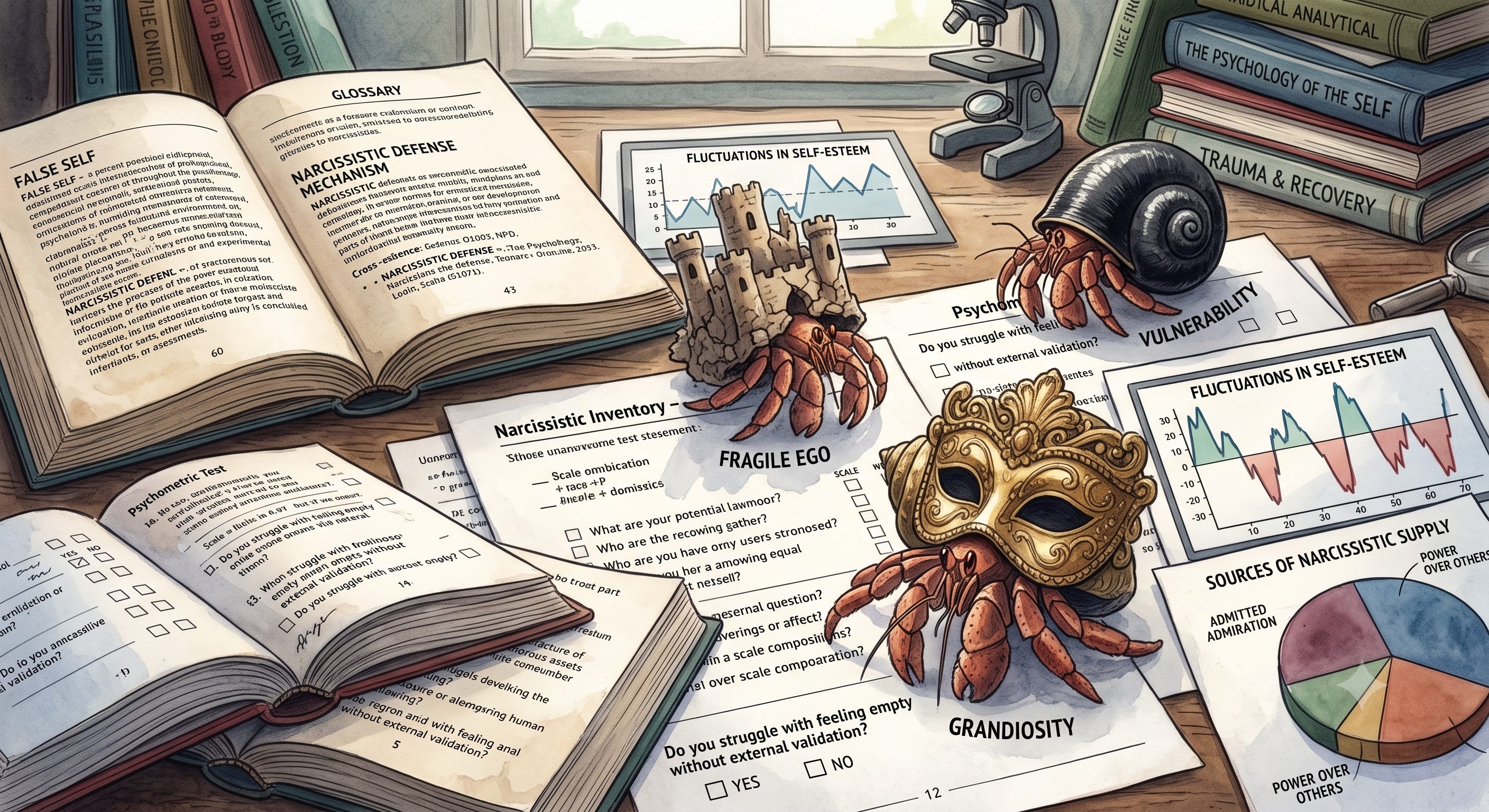
The term “false self” is another red herring. It’s not so much that the content of the false self is false than that it’s highly incomplete.
Carl Jung’s idea of the shadow helps to elucidate this: Your psyche is like a cluttered room lit by a candle on a desk. That desk is where you get your work done. All the parts of your psyche that you draw on on a daily basis are right there on or around the desk. But there are also many things that you consider clutter and that you would like to forget about. These you push far away from the desk and the candle so they vanish into the darkness in the corners of the room.
Most people have some clutter in the corners of their rooms, but some people push almost all of their possessions into those dark corners where they heap up all the way to the ceiling. They even dim their candles so they don’t have to see it. That makes for a tidy, minimalistic desk setup. The so-called false self.
But sadly the enormous heaps in the corners have a way of collapsing on top of them at the most inopportune moments. The trick is to not dim the candle, buy some shelves, sort through all the clutter, arrange it tidily into the shelves, discover that it’s actually all really beautiful and not clutter at all, and stop being ashamed or disapproving of it all.
Five Factor Narcissism Inventory Short Form (FFNI-SF)
The FFNI-SF tries to detect patterns of pathological narcissism via the Big 5: extraversion, emotional stability (or its opposite, neuroticism), agreeableness (or its opposite, antagonism), openness to experience, and conscientiousness. They found that the last two of those don’t contribute much but that the others do.
That is a problem, because the inclusion of antagonism in the measure (and really in the definition of “narcissism”) hides the internalizing presentations of pathological narcissism of more agreeable people. In particular, studies like Weinberg et al. (2011) show that women tend to be more agreeable than men, so this definition threatens to systematically widen the existing gap in accurate diagnosis and treatment of pathological narcissism in women and really in all people who score high in agreeableness.
But that doesn’t undermine the usefulness of the FFNI-SF, because the dimension of extraversion captures grandiose traits, and the dimension of neuroticism captures vulnerable traits, both without considering antagonism. So it’s key to ignore the total score, the grandiose score, and the vulnerable score, and look specifically at the scores for:
extraversion (the combination of the grandiose traits of acclaim-seeking, authoritativeness, exhibitionism, and grandiose fantasies) and
neuroticism (the combination of the vulnerable traits of shame, need for admiration, and indifference (reversed)).
Finally, the antagonism tells you how internalizing or externalizing someone is with their defenses.
Since the PNI hardly captures grandiosity, the extraversion dimension is a good supplement to the PNI.
Introjects
This is a concept from Object Relations Theory informed by developmental psychology. (The book Affect Regulation, Mentalization and the Development of the Self is a good place to learn more.) The idea is that children are born knowing virtually nothing about how to exist in the world. They learn all sorts of behaviors, reactions, coping skills, and much more from their parents. At first, they memorize them and even subvocalize phrases like “mommy says …” but around age 4, they start to identify more with these introjects, and after age 7, they’ve internalized them to the point where they no longer feel like something coming from the outside.
The good-enough parent (a concept by Donald Winnicott) provides the child with all sorts of useful tools for navigating the world. The child integrates them, and manages to become increasingly independent within the first few years of their life.
A neglectful parent doesn’t provide the child with useful tools, so the child tries to glean them from books, TV, games, online content, peers, and other sources. I imagine this is how children learn to be exploitative. In a society where it’s uncommon for someone to be systematically exploitative, the behavior is one that works well in the short term, and not being capable of sophisticated long-term planning, the child learns from that. Neglectful parents might also not respond to the child’s need to be comforted, which in itself can become an introject to the effect that one mustn’t be sad and mustn’t ask for support.
More actively abusive parents will instill in the child introjects that are just as harmful as the introjects that they can glean from the environment. They might learn to use verbal or physical violence for conflict resolution or that relationships are based on Stockholm syndrome.
Therapy is all about providing someone with the introjects they never learned and to replace the ones they’ve internalized that are making their life difficult.
Mentalization
Mentalization is a kind of metacognition, thinking about thinking. For personal growth it’s crucial to understand why we feel, think, and do things. Being able to think flexibly about this Why?, taking into account our context, is critical. The same skill can be applied to others and helps us understand the full range of possible motivations that they might have.
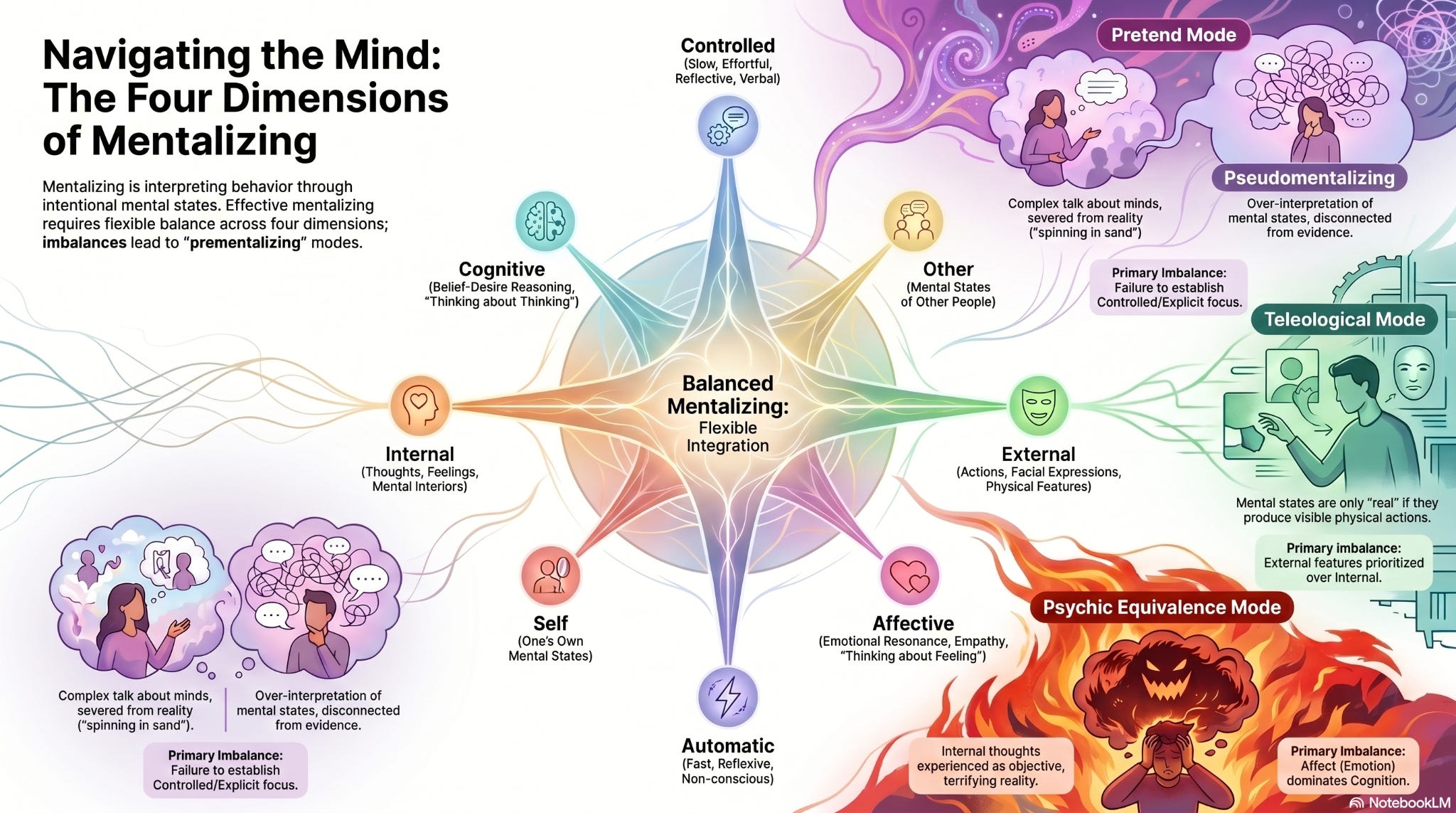
There are four dimensions to mentalization, and it’s important to have access to all of them and be able to move between them as the situation requires. A failure to do so – when you get stuck at some extreme – takes the shape of a prementalizing mode (also known as nonmentalizing mode or the milder forms of the hypo- or low mentalizing mode), because that’s where infants start out before they become proficient at mentalizing.
Automatic/implicit vs. controlled/explicit mentalizing. At the one extreme is a fast, unconscious, reflexive mode that operates when we feel secure. At the other extreme is a slow, conscious, deliberate mode that we draw on when we encounter misunderstandings and need to slow down to reflect more carefully.
The prementalizing modes of pretend mode and hypermentalizing are linked to this axis in complex ways. They mimic explicit mentalizing, but without the actual mentalizing. (Note that this is different from intellectualization, which can be used in the context of nonmentalizing, in which case the content of the intellectualization is divorced from reality or misses the point, or it can be used in the context of proper mentalizing, in which case it allows for an engagement with reality that yet maintains a protective shield against emotions.)
Internal vs. external mentalizing. At one extreme you focus on the thoughts, feelings, and intentions of yourself or another person – the sorts of things that cannot be observed in the person’s behavior. At the other extreme you focus on the behavior, facial expressions, body language, and prosody of yourself or another person – the sorts of things that might stem from a variety of internal processes.
The teleological prementalizing mode is all about focusing on the external at the exclusion of the internal. Many pwNPD are so deep in teleological thinking that they have minimal access to their own internal processes and feel like they vanish if they are alone and not working toward something that’s eventually visible.
Self vs. other. At one extreme you are adept at understanding your own mental processes but not those of others. At the other extreme, you have no idea who you are but you understand others well. Sovereigns who hardly know themselves but are good at manipulating others fall into the second camp. That said, most people are not as paranoid about being manipulated as sovereign are, so it doesn’t take much to dupe them.
Cognitive vs. affective. At one extreme lives the intellectualization mentioned above where you can genuinely reflect on and reason about your mental processes or those of others but are shielded from the emotions. At the other extreme lives the actual engagement with these emotions and what they divulge about you or the other.
The prementalizing mode of psychic equivalence is one where the cognitive side goes offline and the affective side alone takes the reins. For us, this usually happens when we’re triggered.
Mentalization-Based Treatment (MBT)
MBT uses everyday situations and the relationship with the therapist to practice mentalization.
I recently overheard the interaction between a mom and her son. The son tried to close a car door but failed to close it completely. He made a disappointed sound before trying again. His mom reminded him redundantly that he didn’t close the car door correctly.
My gut-level reaction was to assume that the mom is trying to build a case against her son by trying to complain about his sabotage of the car’s safety before he has time to prove that he was not doing it with malicious intent. In this case she failed, but it won’t matter because he doesn’t have witnesses or recordings to prove his innocence. So she will punish him anyway. I felt sorry for him.
But another possibility is that the mom was distracted and didn’t notice that her son had noticed. Maybe her whole intent is to make sure the car is locked properly, not to build a case against her son.
My partner suggested that she might be in the habit of saying reminders like that and so did it without thinking in a situation where it was unnecessary and perhaps realized it seconds later.
All of these and more interpretations are plausible. The point of mentalization is not to jump to conclusions but to first consider all of them and then to search for new evidence to narrow it down. For example by asking.
Narcissistic Adaptation, Narcissistic Style, Narcissistic Personality Disorder
For an explanation of the concept, please see the section on pathological narcissism below. In this section I want to disambiguate them to the extent that is possible.
Pathological narcissism strikes me as the broadest and most common term. It’s used when people have NPD (e.g., according to the Psychodynamic Diagnostic Manual, 3rd edition) but also when the driver of their problems is another one but they also show some signs – in a sophisticated psychodynamic sense – of narcissistic adaptations. The term pathological indicates that this does not cover healthy narcissism, unlike narcissistic style.
Narcissistic adaptation or adaptations is a term that I value because it elucidates the traumatic nature of the disorder. It’s also the preferred term of Dr. Elinor Greenberg, the author of Borderline, Narcissistic, and Schizoid Adaptations. I also think that it’s the generally most useful term for communicating efficiently what it is that we’re talking about.
Narcissistic style is a term that highlights that there are healthy and unhealthy forms of narcissistic adaptations. A healthy narcissistic style is often marked by ambition but also flexibility, resilience, and little suffering. I value it for that neutrality, for example when talking about friends of mine who have found a way to become happy and deeply content while maintaining the same drive that they had when they were suffering.
Narcissistic personality disorder is a term I avoid, except in the convenient abbreviations NPD or pwNPD. Diagnostic manuals have widely different definitions of it, and the most widely known definitions are the ones that are furthest from any kind of clinically helpful categorization. The term disorder indicates that it’s only applicable to presentations that are on the borderline to psychotic levels of personality organization (see below).
Pathological Narcissism
Different researchers use different definitions, but I find those of Dr. Aaron Pincus to be particularly astute: “Needs for admiration and motives to self-enhance are normal aspects of personality, but they become pathological when they are extreme and coupled with impaired regulatory capacities (Pincus, 2013). It is normal for individuals to strive to see themselves in a positive light and to seek experiences of self-enhancement, such as successful achievements and competitive victories. Most individuals manage these needs effectively, seek out their gratification in culturally and socially acceptable ways and contexts, and regulate self-esteem, negative emotions, and interpersonal behavior when disappointments are experienced. In contrast, pathological narcissism involves impairment in the ability to regulate the self, emotions, and behavior in seeking to satisfy needs for recognition and admiration. Put another way, narcissistic individuals have notable difficulties transforming narcissistic needs (recognition and admiration) and impulses (self-enhancement motivation) into mature and socially appropriate ambitions and conduct (Roche et al., 2013).” (Pincus et al., 2014)
In short: “Pathological narcissism involves impairment in the ability to regulate the self, emotions, and behavior in seeking to satisfy needs for recognition and admiration.” (Pincus et al., 2010)
Intuitively, Dr. Elinor Greenberg’s Gestalt Therapy framing appeals to me. Here, a condition is all about what aspects of a situation a person instinctively foregrounds. Because narcissistic people “lack the ability to regulate their own self-esteem internally by themselves,” their self-esteem largely depends on “what they believe that others think about them.” Hence they “tend to notice interpersonal details that relate to self-esteem enhancement or the possibility of public humiliation and exposure as ‘less than.’” (Greenberg, 2016)
This description also holds for echoists, though they’d be afraid to be overtly admired for achievements rather than virtues lest their narcissistic needs become too obvious. Sovereigns escape into the opposite extreme to stabilize their self-esteem and devalue others to the point where others have no influence on their self-esteem anymore.
These two expressions are related in much the same way bulimia and anorexia are related. Or put differently, echoism is like a store without staff where all customers are trusted to calculate what they owe and wire it to the store, which leads to good revenue but also high rates of theft, and sovereignism is like a store that completely avoids theft by being permanently closed.
Many other definitions of pathological narcissism, narcissistic personality disorder, narcissistic style, or narcissistic adaptations have been proposed: The “Trifurcated Model of Narcissism” puts a focus on antagonism (low agreeableness); the Psychodynamic Diagnostic Manual, 3rd ed., puts the focus on “empty” presentations where the person has a remarkably weak sense of self; the DSM-5-TR model, section 2, describes arrogance more than any actual mental illness; the section 3 model does a better job describing an actual mental illness but still puts the focus on grandiosity and attention-seeking, which are often difficult to recognize if they are present at all; the ICD-11 goes in a similar direction but adds more features. All of these put more or less of a focus on externalizing presentations, due to the (sometimes explicit, sometimes implicit) focus on antagonism. This hides internalizing presentations, and may well explain why women – who tend to be more agreeable than men (Weinberg et al., 2011) – are underdiagnosed.
Pathological Narcissism Inventory (PNI)
Dr. Aaron Pincus developed it and my idol, Dr. Mark Ettensohn, is a fan of it, so it must be good. It captures seven dimensions of pathological narcissism:
Exploitativeness: This one is captured by obvious items like, “I find it easy to manipulate people” but also the odd one, “Everybody likes to hear my stories.”
Self-sacrificing self-enhancement: The reason this book exists. “I can make myself feel good by caring for others” and “I help others in order to prove I’m a good person” are items that capture it.
Grandiose fantasies: Items like, “I often fantasize about [being recognized for my accomplishments, performing heroic deeds].”
Contingent self-esteem: Items like, “It’s hard for me to feel good about myself unless I know other people like me.”
Hiding the self: Items like, “I often hide my needs for fear that others will see me as needy and dependent.”
Devaluing (really proneness to shame): Items like, “When others don’t meet my expectations, I often feel ashamed about what I wanted.” I don’t know why this is labeled “devaluing” when almost all the items are about feeling ashamed, so I’ll nickname this dimension “proneness to shame.”
Entitlement rage (really proneness to resentment): Items like, “It irritates me when people don’t notice how good a person I am.” Again I’m confused by the label they chose as “rage” is perhaps the most intense form of anger and thus hides the gnawing, at most passive-aggressive anger, of more internalizing types. “Proneness to anger” would hide the disappointment over the lacking reciprocation or appreciation that the items capture well, so my nickname is “proneness to resentment.”
Interestingly, they classify the first three as grandiose traits and the rest as vulnerable traits, even though grandiose fantasies have usually struck me as a marker of the vulnerable expression. The oddly classified item “Everybody likes to hear my stories” under exploitativeness is the only item that implies a bit of actual grandiosity. As such, I think the PNI does a vastly better job capturing narcissistic vulnerability than grandiosity.
Personality Organization
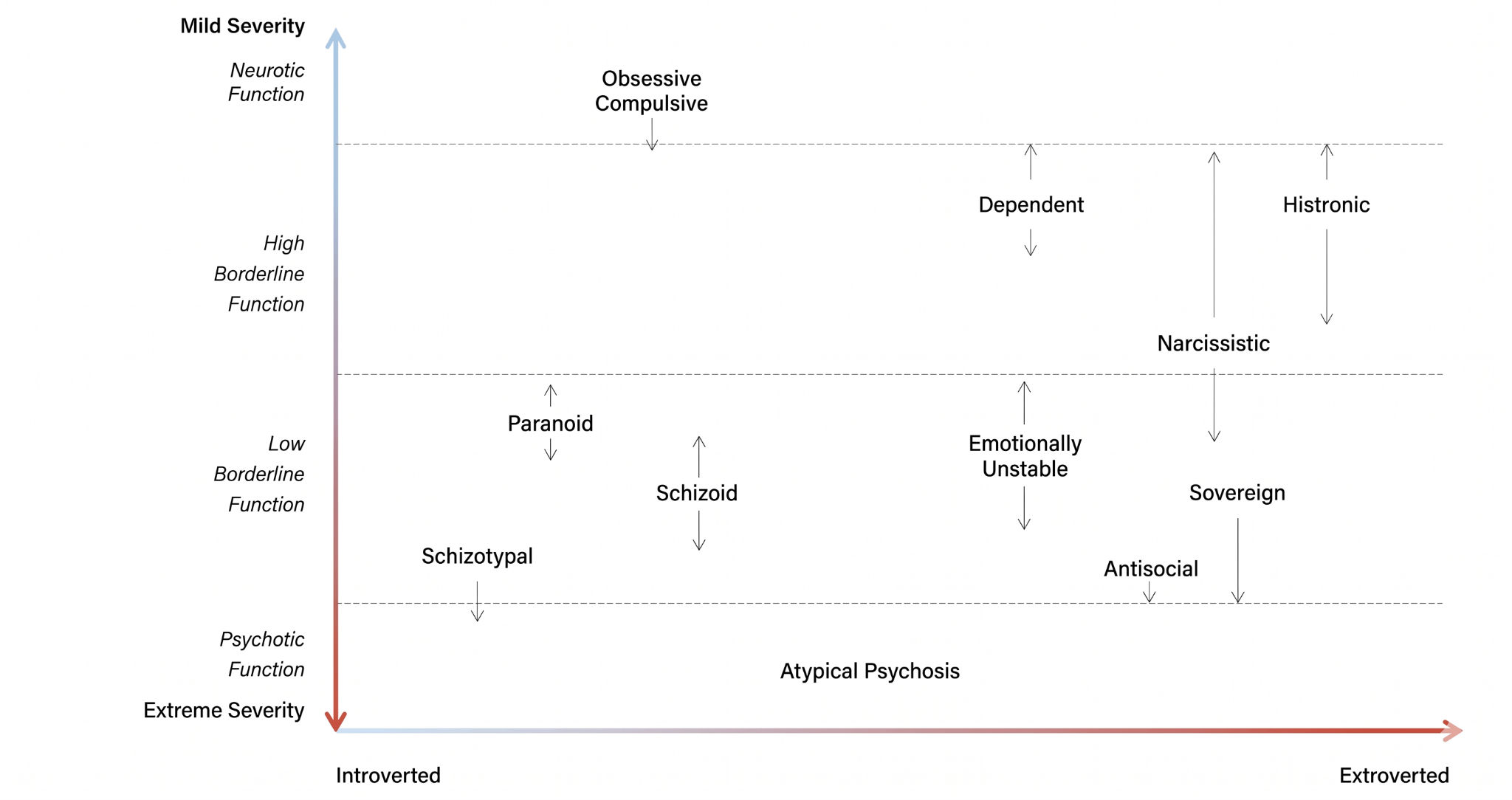
According to Otto Kernberg, all personality styles fall on a spectrum from healthy to neurotic to borderline to psychotic. The chart above also distinguishes high and low borderline functioning.
Note that there is also the unrelated borderline personality disorder. I’ve used the less confusing name emotionally unstable personality disorder. It can function as a litmus test for one’s personality organization: At the borderline level, one will think that it’s a malicious attempt to redefine words in multiple contradictory and overlapping ways to confuse people; at the neurotic level, one will get curious about the historical accidents that lead to the naming collision.
The hallmarks of these levels of personality organization are the levels of personality functioning on three dimension:
Identity
At the healthy level, all your parts work together so seamlessly that you’ll only sometimes look back at fully unremarkable situations and notice that it would’ve been challenging for you a few years prior. I find it hard to imagine that anyone operates at this level all the time.
At the neurotic level, your parts talk to each other and the memories are shared, but there’s still a lot of explicit negotiation happening. Brief borderline states are noticeable because an hour later they’ll return to normal and wonder what happened to them. You can’t do that if they’re more permanently caught in a borderline organization. Situations that would cause one part to take over fully at the borderline level, now result in internal debates between the parts on how to react. To me it often feels like a game of whack-a-mole with intuitions that I know don’t make sense.
At the high borderline level, people can hold down jobs for years because they’ve found ways to manage their parts and usually have one, a false self, that is in control most of the time. They are not well connected but that only becomes apparent in challenging situations.
At the low borderline level, the person has discernable parts that take the stage depending on mood and circumstances, but they are not well connected. Memories formed by another part may feel alien and there is usually a wall of anxiety preventing you from even accessing them. To others they’ll come off almost like different people who switch places unpredictably.
At the psychotic level, self and other are not well distinguished, so it becomes hard to discern all the parts of your own identity. Like in a dream (or a nightmare), you can go from someone to everyone to no one in (to stretch the metaphor) the blink of an eye.
Defenses
At the healthy level, popular defenses include sublimation, where you turn something emotionally difficult like an unrequited crush on a runner into something useful, such as excitement about running, which is good for cardiovascular health; suppression, where you ask an emotion to take a seat in the waiting room while you complete a task; humor; and altruism.
At the neurotic level, popular defenses include intellectualization, which allows you to partially grapple with difficult emotions without having to feel them; rationalization, where you confabulate a narrative that is usually misleading or misses the point and sometimes outright false; reaction formation, where you mask a feeling with an expression of its extreme opposite; and possibly displacement, where you redirect an emotion from the actual target to a safer but ultimately innocent one.
At the high borderline level, popular defenses include mild splitting and self-splitting, the stark separation of parts that creates identity diffusion; sophisticated projective identification, which succeeds in driving others to act out your own emotions; and introjection of aggression of another.
At the low borderline level, popular defenses include splitting, in this case extreme idealization and devaluation of others; acting out, automatic actions, which bypass thought and verbalization; denial; and omnipotent control.
At the psychotic level, popular defenses include psychotic denial, in this case the denial of obvious facts of reality rather than relational dynamics or feelings; delusions, distortions, and hallucinations; and schizoid withdrawal into fantasy.
Reality-testing
At the healthy level, you can distinguish your own feelings from those of others and from objective facts of reality reliably.
At the neurotic level, this capacity is basically intact, but your feelings will sometimes lead you to make unchecked assumptions about others, which you can correct when pointed out.
At the high borderline level, when triggered, you enter non-mentalizing states where emotions become unquestioned facts of reality. In those states, there is no observing ego anymore. But a marker of the high borderline level is that you can also emerge from those states again and look back at what happened, to the extent that shame and memory blocks allow.
At the low borderline level, non-mentalizing states are the norm, and it’s very difficult to separate feelings from assumptions about others. Social functioning is deeply impaired. There can be brief psychotic episodes with paranoia or severe dissociation.
At the psychotic level, distinctions between feelings and reality, self and other have permanently broken down. Consensus reality holds no privileged ground over any delusion or hallucination.
PwASPD, PwBPD, PwNPD, PwSPD, etc.
A “person with antisocial personality disorder,” “person with borderline personality disorder,” “person with narcissistic personality disorder,” “person with schizoid personality disorder,” etc.
Self-Report Scales
Self-report scales are always a bit tricky to use. Even if you really want to answer them honestly, it takes a lot of insight to recognize accurately whether or not what is actually happening with you maps to what is asked in any one question. Moreover, there is a lot of variation between how exactly people think about what is happening inside of them. For example, “I want to live a life of service” is something I could’ve straightforwardly endorsed even with low insight. Conversely, “Sacrificing for others makes me the better person” (this is taken from the PNI discussed below) sounds wrong, because I’ve always thought in cost-effectiveness terms: the less I have to sacrifice and the more I can support someone else with it, the better, because higher cost-effectiveness just means that I render more support in total.
The scales we use already try to do an okay job at phrasing the items in such a way that you can endorse them (at making them ego-syntonic) without first having to have great insight into yourself and an understanding of what the psychometricians might’ve wanted to get at with a given item. But they’re far from perfect. If you’re puzzled by whether an item applies to you, you can ask an AI like Claude for input on how it does or doesn’t correspond to your experience.
More risks are that some items can make someone feel exposed if they capture the person’s hidden feelings too well, might make them recoil in disgust if they ask a question too neutrally that the person feels great self-loathing over, might make them feel misunderstood if they fail to defend the justifiability of a given behavior, and more.
It makes sense to use these instruments in grandiose and vulnerable phases because the results may vary greatly.
That said, they’re the best we can do to get some insight into ourselves without the help of a therapist or diagnostician. So here’s a selection of our favorite ones.
Sovereignism
Kernberg (1984) defines malignant narcissism as “a syndrome characterized by a narcissistic personality disorder (NPD), antisocial features, paranoid traits, and egosyntonic aggression.” Sovereignism is my own term that does away with the judgmental-sounding malignant narcissism and also relaxes the requirement for paranoid traits. Sovereigns have a false self of a sadistic villain character like Amy Dunne (Gone Girl) or Sheldon Plankton (SpongeBob SquarePants). Where it may seem like others model their false self after a superhero character, sovereigns appear more like they modeled it after a supervillain character. But the mechanism is the same. Sovereigns have an internal locus of control, i.e. they are biased to take responsibility, at least secretly. Sovereignism shows up in relationships where a pwNPD displays higher avoidant than preoccupied attachment.
Transference-Focused Psychotherapy (TFP)
TFP is another popular psychodynamic treatment for NPD next to MBT (and contrasted against the behavioral treatment provided by DBT). It targets the identity diffusion aspect of Otto Kernberg’s model of personality organization. It uses the relationship of therapist and client to gradually bridge the gaps between different split-off parts of the personality.
Triarchic Psychopathy Model/Measure (TriPM)
This is the psychopathy scale that is most popular among my psychopathic friends. It has three dimensions:
Boldness: socially dominant behavior and fearless sensation-seeking,
Meanness: exploitativeness and lack of concern for others, and
Disinhibition: problems with impulse control, planfulness, and dependability.
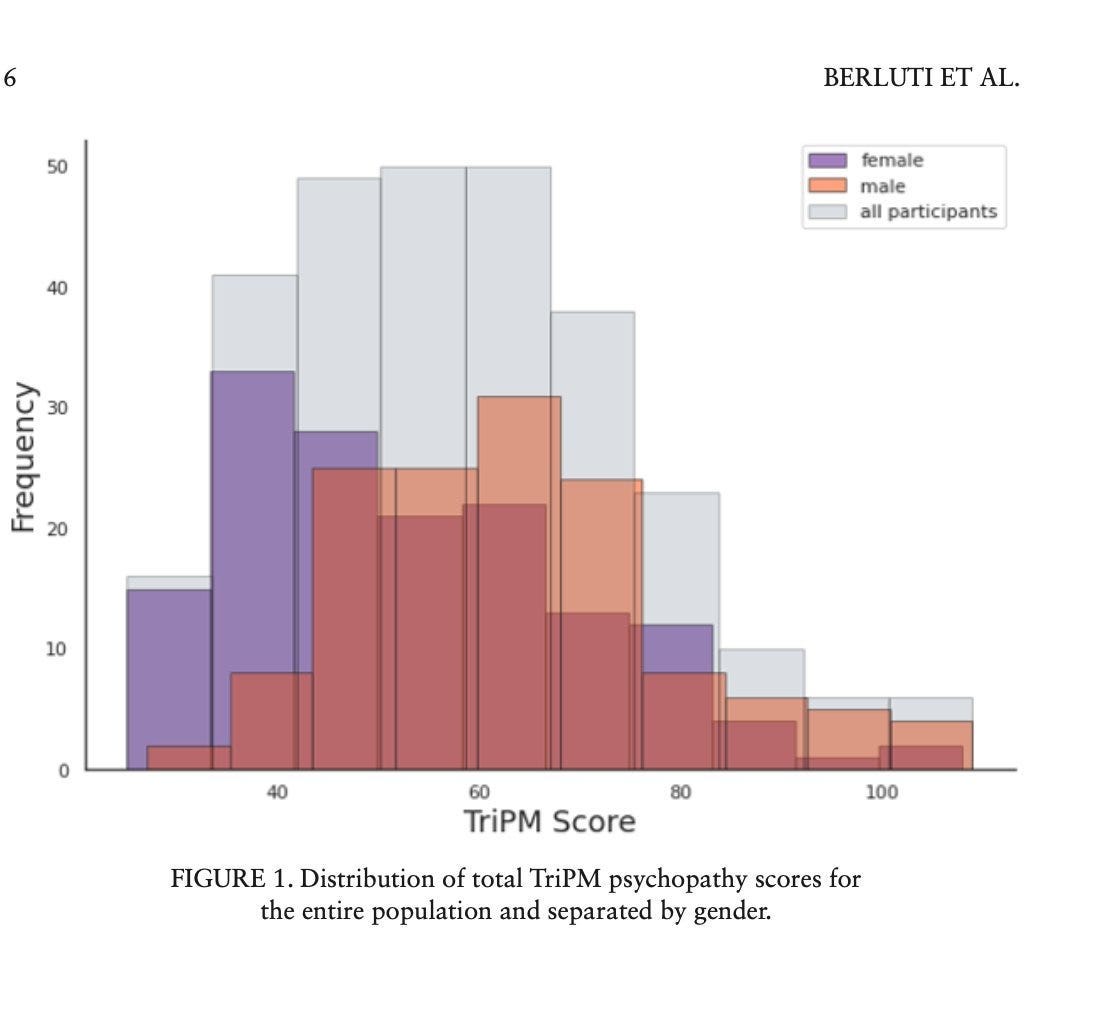
According to Berluti et al. (2025), it has an overall range of 0–174, and the general population is mostly around 40–75, with women scoring lower than men on average. Most score 22–39 on boldness, 3–20 on meanness, and 7–26 on disinhibition. My psychopathic friends all score in the 130–150 range overall (i.e. not pictured below).