

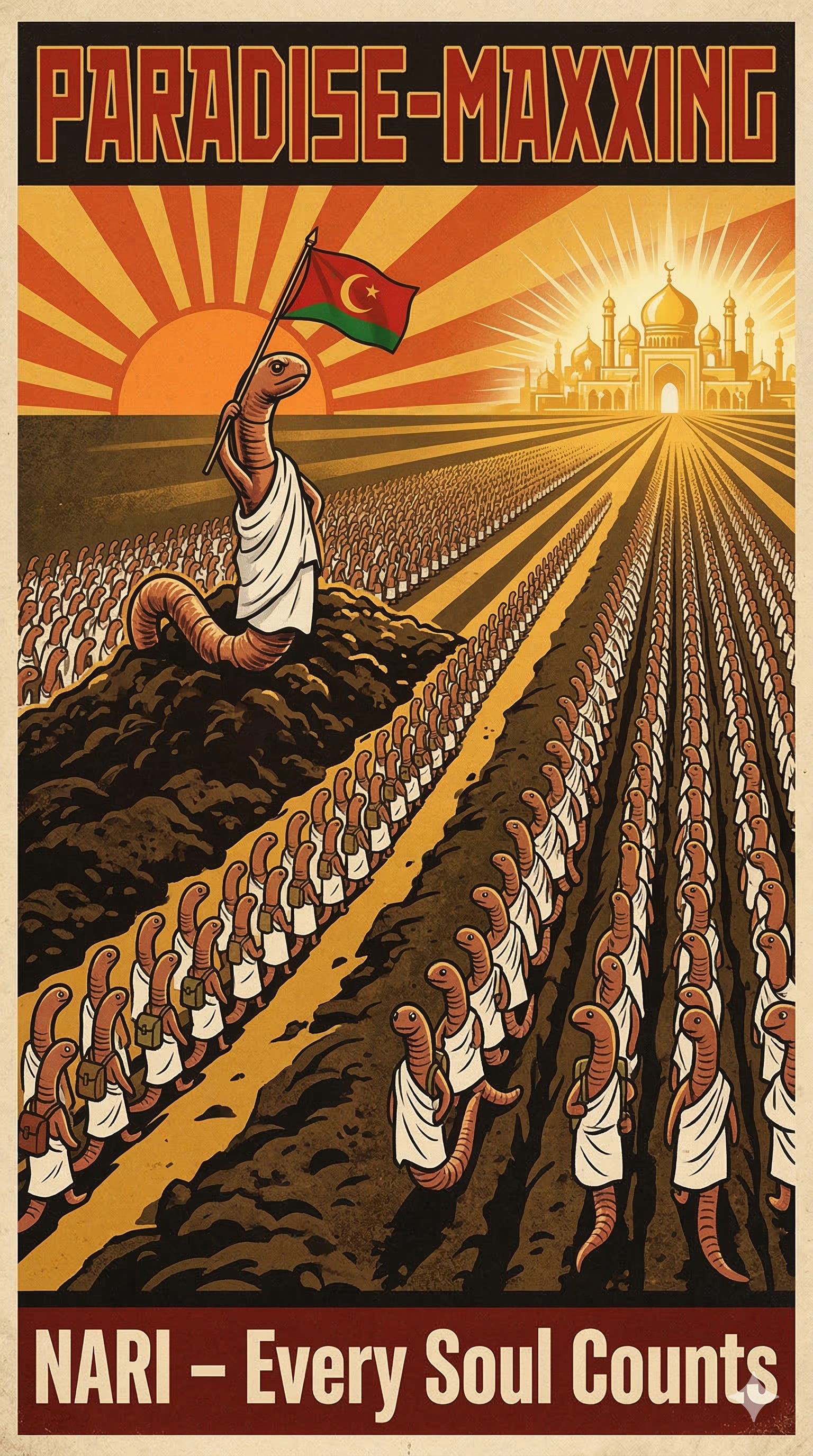
1. The Nematode Welfare Problem
The effective altruism community has spent the last decade steadily expanding its circle of moral concern. First came the global poor, then farmed mammals, then chickens, then fish, then shrimp. The Shrimp Welfare Project now operates at the gold standard of EA animal welfare, deploying electrical stunners at ~1,500 shrimps per dollar per year. Each step followed the same logic: if these beings can suffer, and there are a lot of them, and no one is helping, then we should help.
The latest step in this progression has brought us to nematodes.
There are approximately 4.89 × 10^20 soil nematodes on Earth – roughly 57 billion per human. They are the most abundant terrestrial animals. Many nematode species are heavily r-selected, producing hundreds of eggs per individual, the overwhelming majority of which die within days. As Brian Tomasik argued in his foundational essay “The Importance of Wild-Animal Suffering” for the Center on Long-Term Risk, this reproductive strategy entails staggering amounts of suffering:
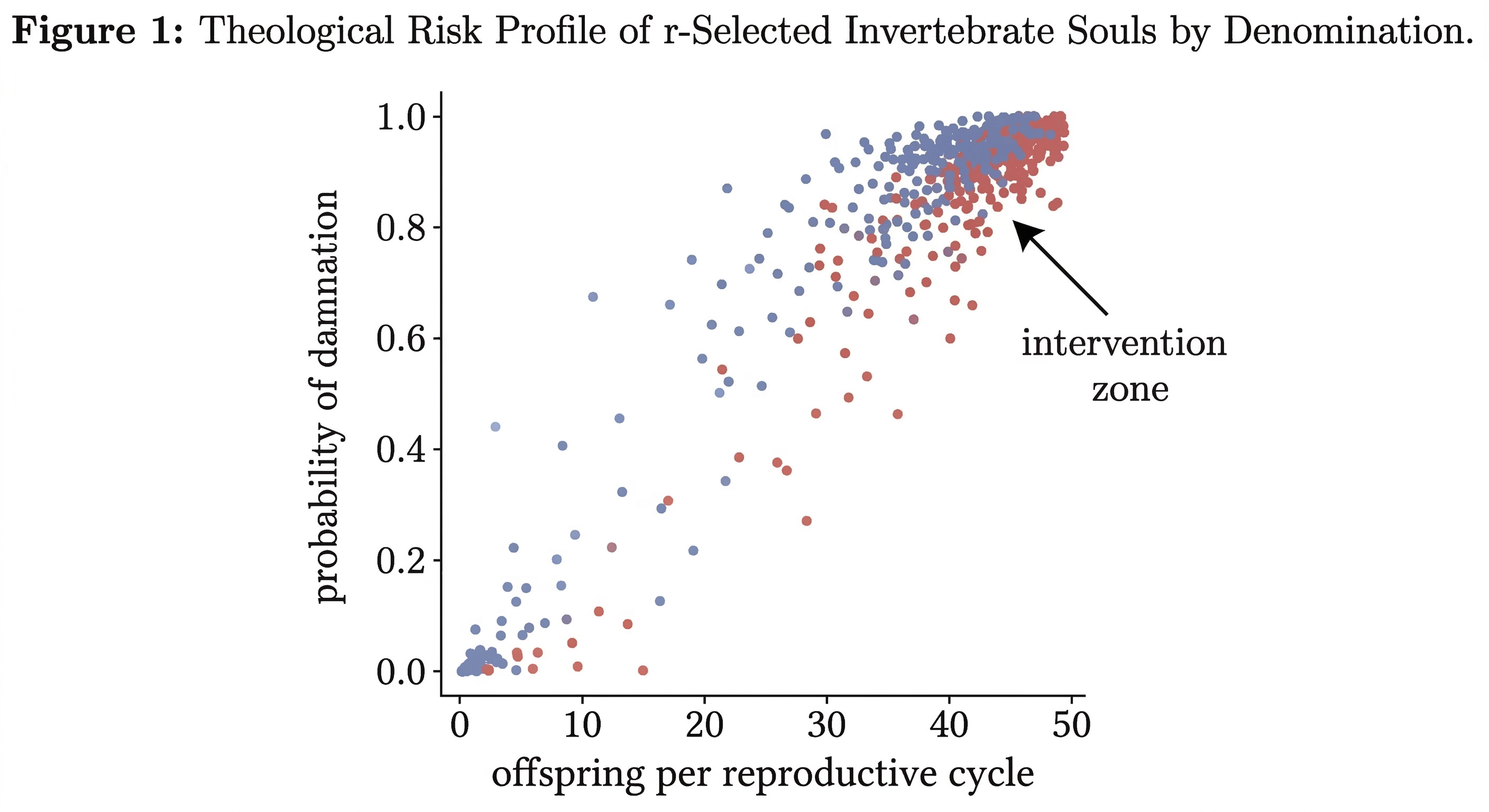
Take a look at this figure from Thomas J. Herbert’s article on r and K selection illustrating extremely high infant mortality for “r strategists.” Most small animals like minnows and insects are r strategists.
In a recent cost-effectiveness analysis, Vasco Grilo estimated that soil nematodes have an annual welfare of -306,000 times that of all humans combined. Not -306,000 nematode-QALYs. Negative 306,000 times the total welfare of the entire human species. Soil mites and springtails add another -24,800×. Grilo calculates that nematodes have negative lives with a probability of 58.7%.
To put this in perspective: if Grilo’s estimates are even approximately correct, then the suffering of soil nematodes is the largest moral catastrophe in the history of the universe, and nothing else is close.
The EA community has been agonizing over this. Grilo’s analysis suggests that the effects of GiveWell’s top charities on soil nematodes are 90,300 times larger than their effects on humans. The impact of broiler welfare corporate campaigns on soil animals is 458 times larger than the impact on the chickens they’re designed to help. These are not fringe claims; they follow directly from taking invertebrate sentience and population numbers seriously.
And yet, after years of research, we remain stuck on the fundamental question: are nematode lives net negative or net positive? The probability hovers agonizingly near 50%. Every intervention that increases or decreases nematode populations carries an expected value that could be astronomically positive or astronomically negative, depending on a welfare estimate that no one can pin down.
What if we’ve been looking at the wrong variable?
2. The Afterlife Reframe
Which theological tradition maximizes the expected afterlife outcome for r-selected invertebrates?
Here is the core insight of this post: if the suffering is this vast and the lives are this short, then the only variable that could decisively swing the expected value calculation is what happens after death.
Consider: a typical soil nematode lives for a few weeks. During that time, it accumulates approximately -4.48 × 10^-6 QALYs of welfare (per Grilo’s estimates). This is a vanishingly small number. The sign is uncertain. We might spend decades of research trying to determine whether it’s -4.48 × 10^-6 or +4.48 × 10^-6 QALYs, and the answer may be forever elusive.
But if any major theological tradition is even approximately correct about the afterlife, then the post-mortem welfare of each nematode is on the order of ±∞ QALYs – or, if you prefer to avoid infinities, at minimum thousands of QALYs for thousands of years of paradise or damnation. The finite lifetime welfare is a rounding error. The sign of the afterlife term dominates everything.
This is not a new observation in the abstract. Pascal noted it in 1670. But no one has applied it to nematode welfare economics, and certainly no one has asked the obvious follow-up question: Which theological tradition maximizes the expected afterlife outcome for r-selected invertebrates?
We call this cause area Effective Afterlife Altruism (EAA), and its primary intervention strategy paradise-maxxing.
3. Methodological Preliminaries
3.1. The Antispeciesist Assumption
Several theological traditions distinguish between human and animal souls – holding, for instance, that animals lack the neshamah (rational/divine soul) of humans, or that animals are resurrected for justice but then turned to dust rather than admitted to paradise.
We reject these distinctions as speciesist.
If nematodes can suffer – which the welfare literature takes as a live possibility, and which Rethink Priorities estimates with a probability of 6.8% for adult nematodes – then they possess the morally relevant features that ground soul-attribution in the first place. Any theology that grants afterlife status to a two-day-old human infant (who has never made a moral choice, formed a belief, or spoken a word) but denies it to a nematode (which also has never done any of these things) is drawing an arbitrary species boundary. Under antispeciesist ethics, we apply infant afterlife doctrines universally.
3.2. Symmetric Total Utilitarianism
Our analysis requires a specific population-ethical framework. Under asymmetric views, preventing bad lives matters but creating good lives doesn’t add value. Under such views, only preventing damnation would matter, and paradise would be irrelevant.
Under symmetric total utilitarianism, however, a life in paradise is exactly as good as an equally bad life in hell is bad. This makes paradise-maxxing a genuine cause area: every nematode soul admitted to paradise represents a real gain in total welfare, not merely the absence of a loss.
We adopt symmetric total utilitarianism for this analysis. Readers who hold asymmetric views may wish to adjust the results accordingly, though we note that even the hell-prevention component alone yields impressive cost-effectiveness numbers.
3.3. Theological Worldview Diversification
Which theology is correct? We don’t know, and we don’t need to.
Coefficient Giving’s framework for worldview diversification offers an elegant solution. Coefficient argues that when facing deep uncertainty across incommensurable moral frameworks, the right approach is to assign nonzero credence to multiple worldviews and allocate resources across them proportionally. They write:
These disagreements can’t be resolved simply by gathering more information. We’re uncertain not just about facts but also about values and methods.
We apply the same logic to theology. Rather than asking “Is Islam correct?” or “Is Catholicism correct?” – questions that cannot be resolved by gathering more data – we assign credence to each theological worldview and optimize our intervention portfolio across them. This means we don’t need any particular religion to be true. We need only that the expected afterlife outcome, weighted across all theologies we assign nonzero credence to, favors one intervention over another.
As we will show, the expected value calculation is dominated by the theological traditions that pose the highest risk to newborn souls – and by the interventions that most cost-effectively mitigate that risk.
4. A Theological Audit: Ranking Denominations by Newborn Damnation Risk
Islam and Mormonism offer the lowest damnation risk, and strict Augustinian Catholicism offers the highest. The delta between these theologies, applied to 4.89 × 10^20 nematodes, is the largest expected value swing in the history of moral philosophy.
The key question for paradise-maxxing is simple: if a being dies before any plausible age of accountability – as 99%+ of r-strategist offspring do – what happens to its soul?
We surveyed the major theological traditions and ranked them by the percentage risk that a newborn soul fails to reach paradise. The results are sobering.
Tier 1: High Risk (>50%)
Strict Augustinian Catholicism (historical). Original sin is inherited from Adam. Baptism is the ordinary means of its removal. Unbaptized infants go to the limbus infantium – not hellfire, but permanent exclusion from the beatific vision. This was the dominant theological position from Augustine through the mid-20th century. It was never formally defined as dogma, but it was near-universal in Catholic theology. Risk of failing to reach paradise: ~90–100%. Risk of actual torment: low (Limbo is painless deprivation, not fire).
Modern Catholicism (post-2007). The International Theological Commission’s 2007 document, “The Hope of Salvation for Infants Who Die Without Being Baptized,” expressed “grounds for hope” but explicitly declined to offer certainty. The Catechism (CCC 1261) says the Church “can only entrust them to the mercy of God.” This is the Church saying “we don’t know but we hope.” Risk: ~30–70%, genuinely uncertain by design.
Tier 2: Moderate Risk (10–30%)
Eastern Orthodoxy. Rejects the Latin concept of Limbo. Emphasizes God’s mercy and economia (divine flexibility). However, also affirms the normative necessity of baptism. Tends to say “we trust in God’s mercy” without issuing guarantees. Risk: ~15–30%.
Classical Lutheranism. Luther affirmed original sin strongly but also held that God can work faith in infants. The Augsburg Confession condemns the Anabaptists’ denial that children are saved through baptism, but doesn’t clearly address unbaptized infants who die. Risk: ~15–25%.
Anglicanism. Broad tent. The Thirty-Nine Articles affirm original sin. Practice varies from near-Catholic to near-Evangelical. Risk: ~10–25%.
Tier 3: Low Risk (2–15%)
Calvinism / Reformed. Westminster Confession 10.3: “Elect infants, dying in infancy, are regenerated and saved by Christ.” The phrase “elect infants” either denotes (a) a subset of infants (some are non-elect and damned) or (b) all dying infants (they’re all elect by virtue of dying). Most modern Reformed theologians take the generous reading. But the grammar permits the strict one. Risk: ~5–15% on the generous reading; much higher on the strict reading.
Most Baptist / Evangelical traditions. The “age of accountability” doctrine is near-universal, supported by 2 Samuel 12:23 (David on his dead infant: “I will go to him”), Matthew 19:14, and Deuteronomy 1:39. Risk: ~3–10%.
Methodism (Wesleyan). John Wesley’s doctrine of prevenient grace – God’s grace given to all people before they can respond to it – covers infants explicitly. Risk: ~2–5%.
Tier 4: Negligible Risk (~0%)
Mormonism (LDS). Doctrine & Covenants 137:10 and Moroni 8:8–12 are unambiguous: children who die before age 8 are saved in the celestial kingdom. “Little children are alive in Christ.” This is the clearest affirmative doctrine of any Christian denomination. Risk: ~0%.
Islam (mainstream Sunni and Shia). Every being is born in a state of fitrah – natural purity and submission to God. Children who die before reaching puberty (bulugh) go directly to paradise. The hadith in Sahih al-Bukhari 7047 describes the Prophet Muhammad seeing children of both Muslims and polytheists playing together in paradise. Scholarly consensus is near-universal. Risk: ~0%.
Judaism (all major streams). Gehinnom (the closest equivalent to “hell”) is temporary purification lasting at most 12 months, not eternal damnation. Children are not considered sinful. Most Jewish theology de-emphasizes the afterlife entirely. Risk of permanent negative outcome: ~0%.
Zoroastrianism. Children under 15 are not judged. Automatic paradise. Risk: ~0%.
Universalist Christianity. Everyone is eventually saved regardless. Risk: 0% by definition.
Tier 5: Orthogonal (No Permanent Hell)
Hinduism, Buddhism, Jainism, Sikhism. These operate on reincarnation frameworks without a permanent heaven/hell binary. A being that dies young is reincarnated based on accumulated karma, not infant sin. There is no permanent damnation risk but also no permanent paradise outcome in the Abrahamic sense. These traditions are largely orthogonal to the paradise-maxxing calculus, though they contribute to the portfolio via reincarnation-quality optimization, which we leave for future research.
Summary
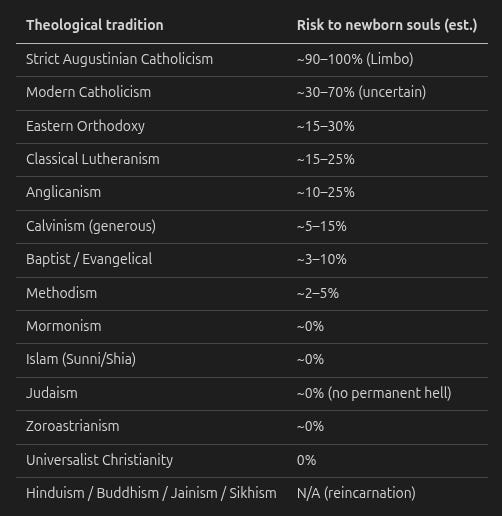
The upshot is clear: for r-strategist invertebrates that die before any conceivable age of accountability, Islam and Mormonism offer the lowest damnation risk, and strict Augustinian Catholicism offers the highest. The delta between these theologies, applied to 4.89 × 10^20 nematodes, is the largest expected value swing in the history of moral philosophy.
5. The Sufi Complication
Before proceeding, we must address a theological wildcard that could undermine the entire cause area: Sufism.
Sufism is the mystical, esoteric dimension of Islam. While Sufis are Muslims and the fitrah doctrine applies, several prominent Sufi thinkers – especially Ibn Arabi (1165–1240) – developed eschatological positions with radical implications for our analysis.
Universal mercy. Ibn Arabi’s reading of Quran 7:156 (“My mercy encompasses all things”) is not merely descriptive but eschatological: he argues that even the inhabitants of hell eventually experience a transformation of their suffering into a kind of mercy. Hellfire itself becomes cool and pleasant for its inhabitants over cosmic time. Under this reading, the risk of permanent damnation for any being is truly 0%, regardless of religious affiliation, species, or baptismal status.
Wahdat al-wujud (Unity of Being). This central concept in Ibn Arabi’s metaphysics holds that all existence is a manifestation of the single divine reality. Every nematode, every copepod, every soil mite is a theophany – a self-disclosure of God. This is arguably the most radically antispeciesist theology ever devised.
Rumi’s evolutionary mysticism. Rumi’s famous verse – “I died as mineral and became a plant, I died as plant and rose to animal, I died as animal and I was human” – describes a spiritual progression through all life forms, implying each has a meaningful place in the divine economy.
The whirling connection. We note with interest that nematodes move through soil in sinusoidal, spiraling patterns bearing a structural resemblance to the sema (whirling meditation) of the Mevlevi Sufi order founded in Rumi’s name. Whether nematodes are already practicing involuntary sema is a question that deserves empirical investigation, though the jurisdictional implications under Mevlevi jurisprudence are unclear.
The paradox for Effective Afterlife Altruism. If Sufi universalism is correct, then all beings reach paradise eventually, regardless of intervention. This is the “AI alignment goes well and solves everything” scenario of EAA: existential hope that eliminates the cause area entirely.
We therefore assign strategic priority to monitoring Sufi universalism but not banking on it. In portfolio terms, Sufi universalism enters our model as a discount factor on the urgency of intervention – perhaps reducing the expected marginal value of paradise-maxxing by 5–15%, depending on the credence one assigns to Ibn Arabi’s eschatology relative to mainstream Sunni positions. This is significant but not decisive.
Your move, Sufis.
6. Blanket Claims and the Religious Power Struggle
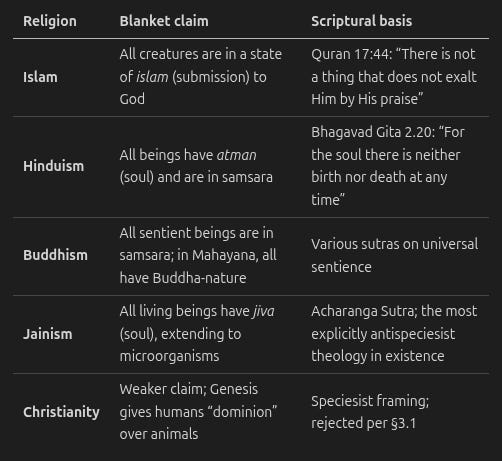
6.1. Which Religions Claim All Animals by Default?
Several theological traditions make universal claims over all living beings:
6.2. These Claims Cancel Out
The real battleground of interfaith dialogue is not the seminary or the public square. It’s the 0–15 cm topsoil layer.
Since Islam, Hinduism, Buddhism, and Jainism all claim every animal, and Christianity’s weaker claim is rejected under antispeciesism, no religion has a stronger inherent claim to a nematode than any other. The theological status of soil fauna is contested territory.
6.3. Active Intervention is Required
If the default is a draw, the only way to shift the balance is through deliberate action. This is exactly the setup for our proposed intervention portfolio.
6.4. The Real Meaning of Religious History
Once you adopt the EAA frame, religious history takes on an entirely new character. The expansion and contraction of religious territories isn’t primarily about human souls – there are only 8 billion of those, a rounding error relative to 4.89 × 10^20 nematodes. It’s about nematode paradise throughput.
The Reconquista (711–1492). When the Moors were expelled from Iberia, approximately 10^15 soil nematodes per year were shifted from ~0% damnation risk (under Islamic fitrah) to ~90% damnation risk (under the Augustinian theology of the Spanish Inquisition). This may be the greatest soteriological catastrophe in history, and no one noticed because they were counting the wrong species.
The expansion of Islam into Southeast Asia. The Islamization of the Malay Archipelago – one of the most nematode-dense regions on Earth, with tropical forest soils harboring ~5.15 million nematodes per m² – was the single most effective paradise-maxxing event in history. Not because of the human converts, but because of the soil fauna.
The Great Commission. Jesus instructed his followers to “go and make disciples of all nations” (Matthew 28:19). The Church has historically interpreted “nations” as referring to human ethnic groups. Under antispeciesist theology, the commission extends to all ~8.7 million species on Earth. Christianity has focused almost exclusively on one of them – a catastrophic failure of scope sensitivity. Islam, by claiming all creatures through fitrah, has been unknowingly ahead on this metric for 1,400 years.
The church bell problem. Consider a European church bell, audible within a ~3 km radius. The average density of soil nematodes in European temperate forests is ~8.75 million per m². A single bell toll covers ~2.83 × 10^7 m², or approximately 2.48 × 10^14 nematodes. If acoustic proximity constitutes even weak evidence of religious affiliation – and many theological traditions hold that exposure to sacred sound has soteriological significance – then every bell toll potentially Christianizes trillions of nematodes, shifting them from contested theological status to nonzero Augustinian damnation risk.
Conversely, the adhan (Islamic call to prayer) from a mosque re-Islamizes them. The real battleground of interfaith dialogue is not the seminary or the public square. It’s the 0–15 cm topsoil layer.
7. Competitor Analysis
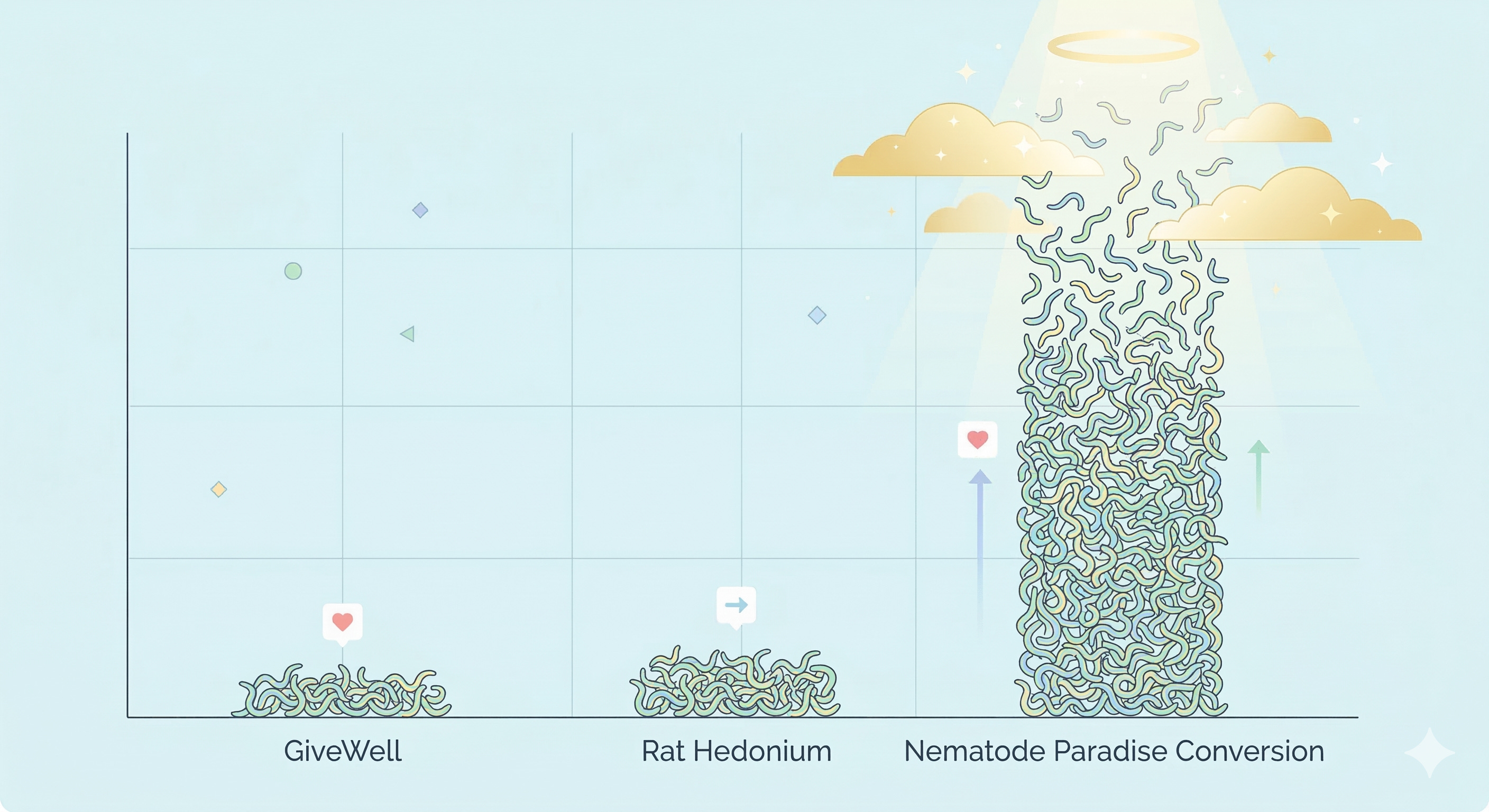
Every EA organization that isn’t doing nematode conversion is leaving infinite QALYs on the table.
Paradise-maxxing does not exist in a vacuum. Several other interventions target the nematode welfare problem. We evaluate them here for comparison.
7.1. Habitat Reduction (the Secular Approach)
If nematode lives are net negative, then reducing their populations is beneficial. Grilo estimates that cropland replacing tropical grasslands increases the welfare of soil animals by 8.15 QALYs per m²-year, of which 93.2% comes from reducing nematode-years. This approach has two problems: first, the sign depends on the net-negative-lives assumption (58.7% confidence); second, even if the lives are net negative, we’re only eliminating a finite amount of finite suffering. There is no afterlife upside.
7.2. Humane Insecticides
Proposed by Brian Tomasik and discussed by Michael Dickens on the EA Forum, humane insecticides aim to make pesticide-induced death less painful. With 3 billion tons of pesticide sprayed annually, the scale is enormous. But again: the intervention addresses the process of death without changing its eternal consequences. A nematode killed humanely by a blessed insecticide and a nematode killed humanely by an unblessed insecticide experience the same temporal welfare improvement. Only the blessed one gets the afterlife benefit.
7.3. Rat Hedonium Farms (Dickens, 2015)
In his 2015 EA Forum post “Charities I Would Like to See,” Michael Dickens proposed creating farms of small animals made as happy as possible – essentially producing pure hedonium. His back-of-the-envelope calculation put the cost at ~$120 per rat-QALY, or ~$240 per human-equivalent QALY (assuming rat happiness is half as morally significant as human happiness).
One could imagine augmenting this with pharmacological assistance: the right opioids might produce welfare states approaching paradise-level bliss. Call it chemical paradise. At its best, chemical paradise might be approximately as good per unit time as theological paradise.
But it doesn’t scale. The rat hedonium farm requires physical space, ongoing feeding, veterinary care, and drug administration. It produces welfare for one rat at a time, for ~2 years per rat. Nematode paradise conversion, by contrast, requires one solar-powered speaker and covers billions of souls per dollar, each for eternity.
The comparison reduces to: Would you rather produce 2 years of approximate-paradise for one rat, or eternal actual-paradise for 10^10 nematodes? Under symmetric total utilitarianism, this is not a close call.
7.4. Shrimp Welfare Project’s Humane Slaughter Initiative
The Shrimp Welfare Project is, by Grilo’s estimates, the most cost-effective animal welfare organization in EA at ~639 QALYs per dollar. Their electrical stunners are deployed at ~1,500 shrimps per dollar per year. This is extraordinary work.
But it operates entirely within the temporal welfare framework. The stunners reduce the suffering of the last few minutes of a shrimp’s life. They do not change what comes after. Even at 639 QALYs per dollar, SWP is producing finite welfare improvements for finite lifespans.
7.5. Nematode Paradise Conversion
Now consider the EAA approach:
One solar-powered speaker (~$50) broadcasting the shahada covers a ~100 m radius. That’s ~31,400 m² of soil. At the cropland nematode density of ~1.24 million per m², we reach approximately 3.9 × 10^10 nematodes within the acoustic footprint. Nematode generations turn over in weeks, so within one year, the speaker covers hundreds of billions of nematode-lives.
Even under extremely conservative assumptions:
Probability of Islam being approximately correct: 1%
Paradise discounted from ∞ to a very conservative 1,000 QALYs (roughly one human lifespan of perfect health)
Nematode welfare range: 6.68 × 10^-6 (per Grilo, applying Rethink Priorities’ neuron-based welfare range methodology)
The expected value per speaker per year is:
3.9 × 10^10 nematodes × 6.68 × 10^-6 welfare range × 1,000 QALYs × 1% = ~2,604 QALYs
At $50 per speaker, that’s ~52 QALYs per dollar – competitive with SWP’s Humane Slaughter Initiative even before we consider that the speaker lasts for multiple years without recurring costs.
And if you don’t discount paradise duration to 1,000 QALYs? If you take the theological claims at face value? Then we’re in Pascal’s Mugging territory, and the expected value is infinite. At that point, every EA organization that isn’t doing nematode conversion is leaving infinite QALYs on the table.
8. Cost-Effectiveness Summary
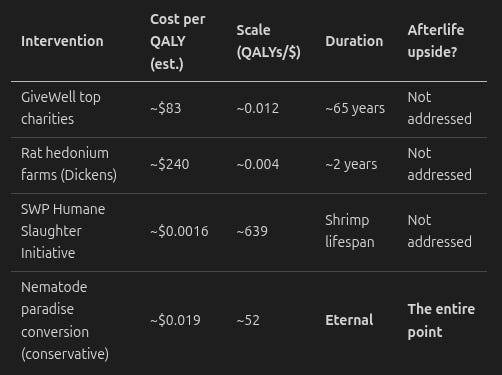
Note: The “conservative” estimate for nematode paradise conversion assumes only 1% probability of the relevant theology being correct and caps paradise at 1,000 QALYs. Under less conservative but still defensible assumptions, the cost-effectiveness exceeds all comparators by orders of magnitude.
9. Proposed Interventions
European church bells … may be the largest ongoing source of soteriological harm on the planet.
Having established the theoretical basis for Effective Afterlife Altruism, we now propose a portfolio of concrete interventions.
9.1. The Shahada Speaker Network
Concept. Deploy solar-powered speakers broadcasting the shahada (la ilaha illallah, Muhammadur rasulullah) in high-nematode-density soils.
Site selection. Boreal forests offer the highest nematode density (~9.26 million/m²), followed by temperate forests (~8.75 million/m²) and tropical/subtropical forests (~5.15 million/m²). Cropland has the lowest density among vegetated biomes (~1.24 million/m²). This means that converting forests to cropland is bad for paradise-maxxing cost-effectiveness: fewer nematodes per m² means fewer souls per dollar. For once, deforestation is bad not just ecologically but soteriologically.
Acoustic considerations. Soil attenuates sound rapidly, but low-frequency vibrations penetrate effectively. The shahada could be optimized for low-frequency transmission. Further research is needed on whether nematode mechanoreceptors can detect shahada-frequency vibrations and whether detection constitutes “exposure” under relevant theological frameworks.
Cost-effectiveness. As calculated above: ~52 QALYs per dollar under conservative assumptions. With a modest deployment of 1,000 speakers ($50,000 total), the network would cover ~3.14 × 10^7 m² and reach ~3.9 × 10^13 nematodes per generation – roughly 10^15 nematode-lives per year. Annual expected value: ~2.6 million QALYs (conservative).
9.2. Halal Ecosystem Certification
Concept. Declare entire biomes as Islamic territories, such that every organism born within them is born on sacred Islamic ground.
Precedent. Bodies of water have been granted legal personhood in New Zealand and India. If a river can be a legal person, a pond can be a legal mosque. Every copepod born in a legally certified mosque is born in a state of fitrah on sanctified ground.
Implementation. Partner with sympathetic Islamic legal scholars to issue fatwas certifying specific ecosystems. Begin with small, contained bodies of water (ponds, vernal pools) and scale to wetlands and forest floors.
9.3. Counter-Missionary Work: The Church Bell Problem
The problem. European church bells, audible within ~3 km, potentially Christianize trillions of soil nematodes per ring, shifting them from contested theological status to nonzero Augustinian damnation risk. This may be the largest ongoing source of soteriological harm on the planet.
Proposed interventions:
Lobby for church bell restrictions in nematode-dense habitats (temperate and boreal forests).
Install offsetting muezzin speakers within the acoustic footprint of churches.
Fund research into the acoustic theology of soil vibrations: does a bell toll 10 meters underground constitute religious exposure?
Quantified impact. A single church in a European temperate forest, ringing bells three times daily, potentially Christianizes ~7.4 × 10^14 nematodes per year. Silencing it, or offsetting it with a muezzin, could prevent ~6.7 × 10^14 unnecessary damnation-risk-years annually (at ~90% damnation risk under strict Augustinian theology, discounted by our credence in that theology).
9.4. Imam-Blessed Pesticides
Concept. We spray 3 billion tons of pesticides annually (Pimentel). These kill enormous numbers of invertebrates. If an imam blesses the chemicals before application, the organisms die as Muslims, with their fitrah status reinforced at the moment of death.
Cost. Near-zero marginal cost. One imam can bless an industrial batch of pesticide in minutes. The theological value-add per dollar is astronomical.
A note on humane insecticides. This intervention pairs naturally with Tomasik’s proposal for humane insecticides. Combine the two: insecticides that kill painlessly and have been blessed. You address both temporal and eternal welfare in a single application. The ultimate in holistic nematode care.
9.5. The Stained Glass Trap
Observation. Many insect species are phototactic – drawn to light. Churches with illuminated stained glass windows act as insect conversion traps, drawing moths, beetles, and flies into sustained proximity with Christian symbols, hymns, and liturgy.
Research needed. Does prolonged exposure to church-interior acoustics and lighting constitute involuntary conversion? If so, churches are the largest unregulated insect Christianization operations in the world. Every moth circling a church light may be undergoing baptism-by-proximity.
Proposed intervention. Install UV-filtering glass in church windows to reduce phototactic insect attraction, or counter the effect by placing small speakers playing the adhan near church-adjacent insect habitats.
9.6. Opposing Habitat Destruction in Muslim-Majority Countries
The logic. Every hectare of Malaysian or Indonesian rainforest destroyed eliminates millions of soil nematodes whose souls, under the fitrah doctrine and geographic Islamic context, were headed straight to paradise. This reframes tropical deforestation in the Muslim world not merely as an ecological catastrophe but as a theological one: a net reduction in paradise throughput.
Conversely, creating new habitats in Muslim-majority countries – reforestation, wetland restoration, agroforestry – is a paradise-maximizing intervention with co-benefits for biodiversity and carbon sequestration. Effective Afterlife Altruism may be the first EA cause area with perfect alignment between ecological and soteriological goals.
10. Worldview Diversification Applied to Theology
Coefficient Giving’s worldview diversification framework provides the meta-level structure for our intervention portfolio. We face deep uncertainty not just over empirical questions (are nematodes sentient? how many QALYs does paradise contain?) but over metaphysical questions (which theology, if any, is correct?).
These uncertainties are incommensurable in exactly the way Coefficient describes:
Worldviews are often incommensurable, meaning there’s no obvious shared scale on which to measure them. One worldview might place enormous moral weight on preventing animal suffering; another might focus on improving human wellbeing today; another on safeguarding the long-term future.
Replace “preventing animal suffering” with “maximizing paradise admissions” and “safeguarding the long-term future” with “preventing eternal damnation,” and you have the EAA portfolio allocation problem.
Portfolio allocation. Just as Coefficient diversifies across global health, catastrophic risk, scientific progress, and animal welfare, we diversify across theological worldviews:
Islamic worldview (~0% newborn damnation risk): Highest allocation. Islam offers the best afterlife outcome for r-strategists with the strongest doctrinal basis.
Mormon worldview (~0% risk): Secondary allocation. Doctrinally clear but smaller theological tradition.
Mainstream Protestant worldview (low risk, ~3–15%): Monitor. Age of accountability provides reasonable protection.
Catholic worldview (high risk, ~30–100%): This is our s-risk scenario. Even a small credence in Augustinian theology generates enormous expected disvalue and thus justifies significant hedging resources.
Sufi universalist worldview (0% risk, makes intervention unnecessary): The “everything is fine” scenario. Reduces urgency of all EAA interventions. We account for it as a discount factor.
Reincarnation-based worldviews (orthogonal): Allocated to a separate research program on karma-optimization for invertebrates.
Diminishing returns. Even within Islam (the clear “winner”), marginal returns decrease as we saturate habitats with shahada speakers. At some point, investing in backup theologies – perhaps mass baptism infrastructure for the Catholic s-risk scenario, or LDS-style posthumous ordinances for nematodes – makes portfolio sense.
Cross-pollination. Coefficient notes that “lessons from one area often sharpen our reasoning in others.” In the EAA context: insights from nematode soteriology may inform our approach to shrimp eschatology, and vice versa.
11. Objections and Responses
“Nematodes don’t have souls.” Rejected per our antispeciesist assumption (§3.1). Additionally, Islam explicitly claims all creatures praise God (Quran 17:44), Jainism attributes jiva to all living beings including microorganisms, and Hinduism places all beings in samsara. The religions that deny animal souls are outnumbered, by adherents, by those that affirm them.
“This is Pascal’s Mugging.” Yes, and? The EA community routinely acts on small probabilities of large payoffs. Existential risk reduction assigns significant resources to interventions that reduce risks by fractions of a percentage point per century. If you accept the logic of x-risk funding – small probability delta, astronomical stakes – then you must accept the logic of EAA, or explain why theological uncertainty is categorically different from empirical uncertainty about AI safety interventions. (We suspect the explanation is “I don’t take theology seriously,” which is not an argument but a prior.)
“Animals don’t go to paradise in Islamic theology.” The dominant scholarly position is that animals are resurrected for justice on the Day of Judgment and then turned to dust. However, this differential treatment is rejected under our antispeciesist assumption. If the fitrah applies to human children, it applies to nematode larvae. The theological infrastructure is identical; only the species boundary differs.
“The shahada requires verbal declaration and intentional belief.” A significant theological objection. However, many scholars hold that beings incapable of rational belief – human infants, the severely cognitively disabled – are covered by fitrah without requiring declaration. Nematodes fall squarely into this category. We are not asking nematodes to believe. We are ensuring they are not removed from fitrah by environmental factors (such as church bells).
“Your cost-effectiveness is inflated by free-riding on divine providence.” A subtle and genuinely interesting objection. The argument runs: nematode soteriology achieves its extraordinary cost-effectiveness not through any intrinsic efficiency of the intervention, but by free-riding on God’s pre-existing infrastructure – paradise, the resurrection apparatus, the fitrah mechanism, the entire soteriological stack. We pay $50 for a speaker; God supplies the eternal paradise. This is analogous to how EA policy interventions achieve impressive cost-effectiveness ratios by free-riding on tax revenue and the governmental apparatus: you spend $1 on lobbying, the government spends $10 million implementing the policy, and you claim credit for the whole $10 million of impact at a cost of $1. The cost-effectiveness is real in a consequentialist sense, but it may be exploitative in a virtue-ethical sense – we are extracting infinite value from a system we did not build and do not maintain.
We find this objection thought-provoking but ultimately unpersuasive. First, all EA interventions free-ride on existing infrastructure to some degree. GiveWell’s top charities free-ride on roads, hospitals, and functioning states. SWP free-rides on the shrimp farming industry’s supply chains. The degree of free-riding in EAA is larger (we are, after all, free-riding on omnipotence), but the kind is the same. Second, if God established paradise and the fitrah mechanism, He presumably intended them to be used; we are merely optimizing the allocation of a divinely provided public good. Third, the virtue-ethical objection proves too much: if leveraging divine providence is exploitative, then prayer itself is exploitative – and virtually every theist in history stands guilty. Finally, under consequentialism, the provenance of the QALYs is irrelevant. A QALY produced by free-riding on God is as good as a QALY produced from scratch. We are not above free-riding on omnipotence if the cost-effectiveness justifies it.
12. The Scope Sensitivity Test
The psychologist Daniel Kahneman famously demonstrated that people are willing to pay roughly the same amount to save 2,000 birds from oil spills as to save 200,000 birds. This “scope insensitivity” is considered a major cognitive bias in the EA community.
We propose a theological variant:
Would you donate $5 to save one nematode soul from eternal damnation?
Would you donate $5 to save 10^15 nematode souls from eternal damnation?
If your answer changed, congratulations: you’re scope-sensitive.
If your answer didn’t change – if you feel the same meh at both numbers – then you are exhibiting the same scope insensitivity that leads people to donate equally to saving 1 vs. 1,000 human lives. The EA community has spent two decades fighting this bias. We invite you to fight it here too.
Alternatively, if your answer was “no” to both: Why? If you would donate $5 to save one human soul from eternal damnation, and you accept antispeciesism, and you accept that nematodes have morally relevant experiences, then your “no” requires justification. And “it sounds silly” is not a justification – it’s scope insensitivity wearing a trench coat.
13. Introducing the Nematode Afterlife Research Initiative (NARI)
The imam-nematologist pipeline is, we acknowledge, currently nonexistent. We view this as a market failure.
We are pleased to announce the founding of the Nematode Afterlife Research Initiative (NARI), the world’s first organization dedicated to optimizing post-mortem outcomes for soil invertebrates.
Seed funding goal: $50 (one solar-powered speaker).
Expected impact: ~52 QALYs per dollar (conservative) to ∞ QALYs per dollar (theological face value).
Research priorities:
Acoustic penetration depth of the shahada in various soil substrates (clay, loam, sand, peat)
Whether nematode sinusoidal locomotion constitutes sema under Mevlevi jurisprudence
Whether the Quran’s claim that “there is not a thing that does not exalt Him by His praise” (17:44) is empirically testable via nematode behavioral assays
Development of a Nematode Soteriological Index (NSI) measuring the theological risk profile of soil ecosystems by biome and religious-geographic context
Formal collaboration with the Center on Long-Term Risk to assess the s-risk implications of getting nematode soteriology wrong at astronomical scale
Proposed advisory board:
One imam
One nematologist
One EA fund manager
One Sufi mystic
We are accepting applications for all four positions. Interdisciplinary experience preferred but not required. The imam-nematologist pipeline is, we acknowledge, currently nonexistent. We view this as a market failure.
14. Conclusion: The Worm’s Head Must Point Toward Mecca

In “The Importance of Wild-Animal Suffering,” Brian Tomasik offered a metaphor for the animal advocacy movement:
The animal movement is like a worm: Each body part needs to slowly scooch its way forward to the next step. But the worm’s head also needs to point in the right direction.
We have spent decades debating whether nematode lives are worth -4.48 × 10^-6 or +4.48 × 10^-6 QALYs per year. The welfare estimates hover agonizingly near zero. The sign might never be resolved.
But the afterlife offers ±∞. The finite lifetime welfare term is a rounding error in the eternal expected value calculation. Under theological worldview diversification, with credences spread across Islam, Christianity, and half a dozen other traditions, the expected afterlife outcome for r-strategist invertebrates is dominated by the theological traditions that pose the highest risk to newborn souls – and by the interventions that most cost-effectively mitigate that risk.
The worm’s head needs to point in the right direction.
The direction is Mecca.
We have established that Effective Afterlife Altruism is, under standard EA methodology, plausibly the most cost-effective cause area ever identified. The numbers are real. The theological doctrines are accurately represented. The only question is whether you’re willing to follow the argument where it leads.
If the Shrimp Welfare Project can deploy electrical stunners to 3.3 billion shrimps per year, surely we can deploy one speaker to 39 billion nematodes. If Coefficient Giving can diversify across four secular worldviews, surely we can diversify across fourteen theological ones. If Vasco Grilo can estimate the welfare range of a soil nematode to six significant figures, surely we can estimate the probability of its soul reaching paradise.
The nematodes are waiting. The afterlife is long. The speakers are cheap.
Support NARI. Spread the meme. Convert a nematode today.
References
Tomasik, Brian. “The Importance of Wild-Animal Suffering.” Center on Long-Term Risk. First written July 2009; last edited May 2020.
Grilo, Vasco. “Cost-effectiveness accounting for soil nematodes, mites, and springtails.” EA Forum. June 2025.
Dickens, Michael. “Charities I Would Like to See.” EA Forum. September 2015.
Boddy, Aaron. “Shrimp Welfare Project’s 2030 Vision & Absorbency Plans.” EA Forum. May 2025.
Coefficient Giving. “Worldview Diversification.” Research & Reflections. 2016/2026.
Ng, Yew-Kwang. “Towards Welfare Biology: Evolutionary Economics of Animal Consciousness and Suffering.” Biology and Philosophy 10.3, pp. 255–285. 1995.
Ibn Arabi. Fusus al-Hikam (The Bezels of Wisdom). 1229.
Rumi, Jalal al-Din. Masnavi-ye-Ma’navi. 13th century.
Sahih al-Bukhari, Hadith 7047 (children of Muslims and polytheists in paradise).
Westminster Confession of Faith, Chapter 10, Section 3.
International Theological Commission. “The Hope of Salvation for Infants Who Die Without Being Baptized.” 2007.
Catechism of the Catholic Church, §1261.
Doctrine & Covenants 137:10; Moroni 8:8–12.
I've rarely laughed so hard. Thank you so much!