


Introduction
Five years ago, David Althaus and Tobias Baumann published a delightful article “Reducing long-term risks from malevolent actors.” It focuses on the risk factors that “malevolent actors” pose when it comes to long-term catastrophic effects on civilization.
Large parts of the article are devoted to the screening for 99th percentile “Dark Tetrad” traits – traits of Machiavellianism, narcissism, psychopathy, and sadism. For comparison, I’m in the 7th percentile according to the “Dark Factor” scale.
I think there are many more places where we can intervene.
I propose a circular model where:
Wars and societal collapses cause widespread trauma,
Which causes widespread insecure attachment and personality disorders.
People with these mental health problems are
desperate for power and admiration, and form a large pool from which new authoritarian leaders are likely to emerge, or
desperate for identity and strong leadership, and susceptible to authoritarian leaders.
These are then a risk factor for further wars and societal collapses, perpetuating the cycle.
This model suggests four points at which we can intervene to break the cycle.
I feel deep compassion for the people who are suffering from these personality disorders, so closest to my heart are interventions that prevent them from emerging in the first place.
It should be noted that none of these interventions will show results within a few years, so all of this is only relevant in worlds in which, by some miracle, the AI thing goes well.
Dolores
To humanize the discussion, let’s introduce my fictional composite friend Dolores. She’s loosely inspired by real friends of mine who score high on all four traits of the Dark Tetrad. I’m hoping to show that there is no such thing as evil, but rather that children find quite brilliant adaptations to the extremely challenging environments they are trapped in throughout their childhoods. These can heal in adulthood (when they gain their freedom) in the same way that someone who has lost a foot can learn to walk again with a prosthesis. It often takes only a few years of therapy.
Dolores is an example of someone with NPD and ASPD. Someone with pure ASPD/psychopathy would be less concerned about upholding any particular characteristics of their personality, and someone with pure NPD would try to self-deceive more comprehensively to hide from themselves any of their behaviors that violate their self-image including values.
Psychopathy. Some of Dolores’s ancestors served in World Wars I and II. Others tried to raise children among the dropping bombs. Dolores’s dad worked long hours to provide for the family and his alcohol addiction. She hardly remembers him. Dolores’s mom never showed emotions other than occasional anger and disappointment and thought that emotional empathy was some kind of metaphor because she had never experienced it.
Hence, the epigenetic adaptations from the wars that Dolores inherited were compounded by the avoidant attachment that she developed in early infancy. She didn’t feel a lot of fear or stress or pain in the first place, and when she did, she repressed it with a vengeance, so the corresponding brain regions stayed small and relatively disconnected.
This personality aspect references war and its effects on epigenetics and how trauma is passed down through parenting practices.
Pathological narcissism. Her mom tried to care for her to the best of her limited ability, but Dolores’s twin sister was born with a disability and required all her attention. For a while Dolores cried a lot when her mom was elsewhere seeing doctors with her sister or drinking in her car to unwind. Then Dolores stopped crying for good. Her mom often told her how great it was that she, unlike her sister, never needed any support, was always strong, independent, and in charge, and eventually Dolores started to believe it too. Any feeling of tiredness or sickness or physical injury filled her with unbearable shame like she was unworthy to even be alive if she felt such things. It was so unbearable she repressed it with rage, often within seconds. She must never be weak or dependent on anyone. It wasn’t so much anymore that she didn’t want to disappoint her mom. Rather her mom’s expectations had become her own. They felt like natural law.
This narcissistic false self is (on account of being false) often at odds with reality and requires constant maintenance, for which fame, power, achievement, admiration, and money are useful.
Sadism. She found that if she started fights, the adrenaline pushed those unbearable feelings away, and she felt invulnerable again. To an extent she was, because it was easy for her to ignore any pain and she didn’t need much sleep. But to acknowledge the reason for her misconduct would be to acknowledge her vulnerability, so she told herself that she just righteously punished people for being weak. It wasn’t even a lie. She resented people who showed weakness the same way others resent cheaters. A boy cried because he had sprained his ankle, which had happened to Dolores many times before. One teacher consoled him and another ran to get ice. It made her boil with righteous anger because the alternative would’ve been to feel envious of him, which was unbearable. Once he could stand up again, she tackled him to the ground and dislocated his shoulder so he had something to cry about. She relished his pain and fear and wondered whether she was an archangel sent down to enact the wrath of God. She felt not only powerful, she felt valiant for defending the law of God and merciful because she had long been taking a knife to school but had chosen not to use it.
This kind of righteousness, like any kind of righteousness, is a breeding ground for conflict. (Interestingly, pure psychopathy is unusually immune to this kind of righteousness, which may reduce the risk of some kinds of conflicts.)
Machiavellianism. But then middle school (and her puberty) started and she became the target of older, stronger bullies who made fun of her second-hand clothes. She didn’t care about the clothes, but she would rather die than to not be in charge of a situation like those wretches she had punished. At home she was subservient and invisible; in school she was the punisher. Neither pattern was suitable to respond to these bullies. So she got out her knife, stabbed herself in the shoulder (she felt she had deserved the pain anyway for her weakness), and hid the bloody knife in the bag of the lead bully. Then she reported him to the principal. After a few days of well-rehearsed lies and affected sobbing, the bully got expelled. It was delicious vengeance, but more importantly she relished the ability to control everyone’s realities with her lies. She started to lie habitually so she would always feel in charge. People who are dumb enough to fall for her lies had it coming. But she also enjoyed helping others with their homework and covered for them when they wanted to skip classes. It felt safe that everyone was a little indebted to her, which she could leverage to bolster her popularity and get away with stuff more easily. But she also relished simply being seen as a good person.
In a war zone you don’t walk up to your enemy and complain about the shooting. But she hadn’t had the chance to learn how to function in an environment where assertiveness works, so she had to fall back on her wits. This can be adaptive in the dog-eat-dog world of politics.
Recovery. Shortly before her 18th birthday, she found herself once more in a juvenile detention center for a colorful panoply of alleged crimes – assault, theft, identity theft, possession of illegal drugs, trespassing, driving without a license, driving under the influence, reckless driving, etc. She was sure she would walk free again, because she’s a genius manipulator who can charm her way out of anything. But she could no longer repress the thought that it was perhaps just her age that had protected her from prison sentences. The thought was heavy as a tank and cut through her like a sword. Acknowledge that she can’t control the justice system, go to prison, or kill herself in a final act of defiance? She remembered Ken Follett’s Eye of the Needle, in which an elite spy and assassin with near superhuman skills plays the roles of meek and ordinary citizens to draw no attention behind enemy lines. She could also use her genius and guile to play the role of a model citizen and thereby trick the entire social contract. Her final triumph on her path to complete mastery of social engineering!
But she had to cleverly devise other outlets to get her adrenaline and to continually prove to herself that she’s invulnerable and in charge. Within a year, she excelled at rugby and broke into abandoned buildings at night. Just like the alcohol, it made her life feel a little less empty and gray. Whenever she followed a law so as not to risk prison, she felt like Ken Follett’s cunning spy.
Her problems with the law became minor, but somehow it was still difficult for her to keep friendships for more than a year. She ruminated a lot on her lost friendships even though she felt nothing and always told herself that she doesn’t need anyone. She limited her lies to untestable and inconsequential things so she could still control her friends’ realities but only in ways that didn’t clash with the actual reality. When her friends cried, she stormed out of the room and distracted herself by running people over in Grand Theft Auto so as not to punish her friends for their weakness. Sometimes she punished them by ghosting them for a week, but on some level she knew they’d just think she’s busy. She finally managed to keep some long-term friends – friends who considered her a good, strong, and reliable person.
Years later she started therapy, ostensibly to manage her alcoholism. She quit on or ghosted her first eleven therapists, but the twelfth was a hottie and she gave him a chance. All the lies she told her therapists shaped a persona wholly different from her real self. She told herself that she’s testing their intelligence and hence worthiness to treat her, but really she had never opened up to anyone and was terrified of what they might force her to acknowledge if they knew more.
Over the course of two years, she lied more and more glaringly on purpose hoping he’ll finally catch on. She was ready now, but she still needed to maintain the illusion that she had been testing him because there was no way she could acknowledge having been afraid. Eventually she had enough, screamed at him that she had been lying to him all along, fought back oh-so-shameful tears by throwing her phone against the wall, and then told him what he really needed to know.
Self-awareness was weird for her. Even after another two years of therapy, all her self-deceptions felt just as real to her as always, but now she knew that they were not. These two realities refused to fuse. Maybe it wasn’t time yet and still too threatening. It became easier for her to realize when she had to override her intuitions, which was helpful in her friendships and at work (though the realizations were sometimes a few days late), but her intuitions corrected themselves only ever so slightly. She got diagnoses for NPD and ASPD and learned that other people actually experienced strange sensations like empathy and remorse, that it wasn’t all just pretense. She could also think more strategically about how to self-soothe, explain things to her friends, adjust her environment, replace destructive coping methods with better ones, cut off toxic people without taking revenge on them, and find jobs where her rare adaptations could serve prosocial ends.
Alternative ending. But there is a different world where Dolores didn’t self-deceive into pretending to fool the justice system with her masks but rather vowed to avenge the indignities she had suffered at the hands of the executive and judicial branch. Her plan might’ve involved writing a long list of the names of every employee of the courts and prisons who had limited her freedom, becoming a political leader or starting a military coup to destroy all democratic checks and balances, and personally condemning everyone from her list who’s still alive at that point. But in that world we likely wouldn’t have met.
Esperanza
Dolores represents the leadership side of the cycle – the traits that can drive someone to seek power over others. But the cycle also requires a population susceptible to following such leaders. To humanize that side, let me introduce Esperanza, another fictional composite friend. She’s loosely inspired by real friends of mine who struggle with borderline personality disorder (BPD). Like Dolores, she is a testament to the brilliance of children’s adaptations to dangerous environments – and like Dolores, she can heal.
Esperanza is an example of someone with BPD and predominantly preoccupied-disorganized attachment. Where Dolores learned that needing anyone is shameful and built a fortress of self-sufficiency, Esperanza learned that she desperately needs others but can never predict whether they will help or hurt her. Someone with purely preoccupied attachment would seek closeness persistently without the oscillation – they might be clingy but not volatile. The disorganized component adds a simultaneous fear of the very closeness Esperanza seeks, creating the chaotic push-pull that characterizes BPD.
Disorganized attachment. Esperanza’s mother loved her – she knows this because she has warm memories of being held, read to, and tucked in. But her mother also drank, and the woman who tucked her in and the woman who screamed at her for leaving a cup on the counter were, to a five-year-old’s mind, two different people. Esperanza could never predict which mother would walk through the door. When her mother was sober, Esperanza would run to her and cling. When her mother was drunk, Esperanza froze mid-stride – wanting to run toward her and away from her in the same breath. She learned to read microexpressions with preternatural accuracy, scanning her mother’s face from across the room for the tiny cues that predicted which version was about to appear. It was a brilliant adaptation. She became the most perceptive person in any room she entered. But she also internalized a lesson no child should have to learn: The person who is supposed to keep you safe is the same person who hurts you, and there is no resolution.
This is the developmental origin of disorganized attachment: The caregiver is simultaneously the safe haven and the source of danger. The child cannot develop a coherent strategy for seeking comfort because the very act of approaching comfort activates fear.
Identity diffusion. Without a consistent caregiver response, Esperanza never developed a stable sense of self. When her mother wanted a cheerful daughter, Esperanza was cheerful. When her mother wanted to be left alone, Esperanza became invisible. When her mother cried and needed comfort, Esperanza became the parent. She got so good at becoming what others needed that she lost track of what she herself was. At school, she mirrored her friends – their tastes in music, their opinions, their style. She described herself as “hollow” or like a “mirror.” She was brilliant at empathy – both cognitive and affective – precisely because her survival had depended on it. But when someone asked “What do you want?”, she couldn’t answer without referencing someone else. Her own desires, preferences, and values felt fleeting like flickers of sunlight reflected from the ripples on the surface of a pond.
Identity diffusion – the absence of a coherent, integrated sense of self – is a hallmark of BPD and a direct consequence of disorganized attachment. It creates an interpsychic chaos of disparate identity fragments in desperate search of any kind of order or stability. Where Dolores’s false self is a rigid fortress she maintains at all costs, Esperanza’s self is a bucket of shards of a shattered mirror.
Emotional dysregulation. Other children seemed to have a volume knob for their emotions. Esperanza had an on/off switch. A perceived slight from a friend didn’t sting a little – it felt like annihilation, like being five years old and abandoned all over again. Joy didn’t build gradually – it detonated. She couldn’t soothe herself because she had never been consistently soothed. When the emotional pain became unbearable – and it became unbearable often – she found that pressing a blade against her forearm produced a strange, immediate calm. The sharp physical sensation cut through the emotional noise the way a slap across the face might startle someone out of a panic attack. She wasn’t trying to die. She was trying to feel one thing instead of everything at once. Later she discovered other methods – binge eating, reckless driving, losing herself in intense relationships with near-strangers – each of them an external regulator for an internal system that had never been calibrated.
This desperate search for external regulation is the behavioral expression of what the attachment system was supposed to provide but didn’t: a way to modulate overwhelming emotions through connection with a reliable other. Without it, the person is left searching for substitutes wherever they can be found. Where Dolores’s adrenaline-seeking pushes vulnerability away, Esperanza’s crisis-seeking is an attempt to make the pain legible, to convert chronic emotional chaos into something with a clear cause and a clear end.
Idealization. Esperanza fell in love the way other people fall off cliffs. When she met someone confident and certain – a new best friend, a romantic partner, a mentor – something specific happened: The dopamine reward circuits flooded and her inner critic went quiet. The person was perfect. They understood her like no one ever had. She felt safe for the first time in months. She rearranged her life around them within days. She adopted their opinions, their vocabulary, their goals. This wasn’t infatuation in the ordinary sense – it was her identity diffusion finding a temporary fill, her attachment system finally latching onto someone who might be the reliable caregiver she never had.
And then, inevitably, they did something imperfect. They cancelled plans. They disagreed with her. They looked at their phone while she was talking. And the perfect person became the dangerous person – not somewhat flawed, but fundamentally unsafe. The same splitting defense that had once helped a five-year-old manage the contradiction of a loving and terrifying mother now divided Esperanza’s adult world into saints and demons, with nothing in between. Friends learned to dread the phone calls: “She’s the most amazing person I’ve ever met” one week, “She never cared about me” the next.
This idealization-devaluation cycle is the interpersonal signature of BPD. It is also the mechanism that makes someone with these traits maximally vulnerable to authoritarian leaders, cult recruiters, and anyone else who presents themselves with enough confidence to be momentarily mistaken for the answer to a question the person has never been able to articulate.
The cult. At 23, Esperanza was between devaluations – recovering from a devastating breakup that felt, as breakups always did for her, like a death. A friend brought her to a weekend retreat run by a “personal development” community. The leader was magnetic. He spoke as if he could see straight through her, and what he saw was beautiful. For the first time someone told her who she “really” was, and it was someone worth being. The community offered everything her attachment system had always craved: unconditional warmth during the initial love-bombing, a clear set of rules and rituals that provided the external structure her emotions required, a shared identity she could borrow without shame, and a group that promised never to leave her.
She moved in within a month. She volunteered 60 hours a week. She stopped calling her old friends – not because anyone explicitly told her to, but because the leader framed outside relationships as evidence of insufficient commitment, and she couldn’t tolerate the possibility that he might be right. When her sister called to say she was worried, the leader said: “People who love you want you to grow. People who try to pull you back are afraid of your power.” It made sense. Everything he said made sense. That was the point.
But the leader was not consistently kind. He publicly praised members who submitted and publicly humiliated those who questioned. He demanded demonstrations of loyalty at unpredictable intervals. He was, in the language of Alexandra Stein’s Terror, Love and Brainwashing, a “frightening-yet-caregiving” attachment figure – and he was recreating, at the group level, exactly the disorganized attachment dynamic that had defined Esperanza’s childhood. The difference was that this time she had chosen it, which made it feel like freedom.
Cult leaders and authoritarian figures exploit the same psychological mechanisms: They offer a powerful identity to those with identity diffusion, external emotional regulation to those who can’t self-regulate, and unconditional belonging to those with abandonment terror – then use intermittent reinforcement and loyalty tests to create a bond that is as difficult to leave as a childhood home. The leader is a Dolores – someone whose avoidant grandiosity fills the exact hole that preoccupied-disorganized attachment leaves open.
The trap. Leaving the group activated the same neural alarm as childhood abandonment. She had no stable self to fall back on outside the group identity – they had given her one, and outside their walls it evaporated. She tried once, after a particularly humiliating group session, and lasted eleven days. She called old friends at 3 a.m. and was met with “I told you so,” which confirmed the leader’s claim that outsiders don’t understand. She went back. The relief of returning was so intense that it cemented the bond further: The group was the only place the pain stopped.
The difficulty of leaving a cult or abandoning an authoritarian leader mirrors the difficulty of leaving an abusive relationship. In all three cases, the attachment system is not responding to whether the other person is good for you – it is responding to whether the other person is familiar to your nervous system. For someone with disorganized attachment, a frightening-yet-caregiving figure feels like home. An actually safe environment feels alien and therefore threatening.
Recovery. She left during a different kind of crisis – the leader turned his full attention to a new favorite and Esperanza experienced the cold side of idealization she had inflicted on others so many times before. For once, the pain of staying exceeded the terror of leaving. A former member she’d kept in secret contact with – her one remaining thread to the outside – helped her find a therapist who specialized in dialectical behavior therapy (DBT), which was developed specifically for BPD.
The early months were brutal. Without the group, she had no identity, no structure, no one telling her who to be. She filled the vacuum with crisis after crisis – a pattern her therapist gently named rather than punished. Slowly, through distress tolerance exercises that gave her something to do besides self-harm, through interpersonal effectiveness skills that replaced her fawning and mirroring with assertiveness, and through the hardest skill of all – sitting alone in a quiet room without texting anyone – she discovered that she could survive being alone. That she had, in fact, always been alone, even inside the group. The group had provided the feeling of safety through enmeshment. Actual safety, it turned out, required something she’d never tried: autonomy.
She began to distinguish her own preferences from the borrowed ones. She realized she liked folk music, not the electronic music her ex had liked, not the devotional music the group had played. She liked dogs, not cats. She wanted to be a nurse, not a “healer.” These were small discoveries, but each one was a brick in a self that was, for the first time, being built from the inside rather than plastered on from the outside.
The splitting didn’t stop overnight. She still caught herself dividing the world into saints and demons, but she learned to notice the split and hold it, the way you might notice you’re clenching your jaw and consciously relax it. Her therapist didn’t become a saint. Esperanza hated her sometimes and said so, and her therapist survived it, and this turned out to be the most therapeutic thing of all: a relationship that could contain both feelings without collapsing.
Alternative ending. But there is a different world where Esperanza never encountered the cult – or, more precisely, where she encountered something worse. In that world, her country was in the grip of an economic crisis. The job she’d built her borrowed identity around vanished. The leader wasn’t a guru in a retreat center but a politician on a screen, and the group wasn’t a few dozen people in a compound but millions who gathered at rallies and online forums, all of them hungry for the same thing she was: someone to tell them who they are, who to blame, and that the pain would stop. In that world, she didn’t lose a few years to a cult. She lost her capacity to evaluate her own government. And she had plenty of company.
Attachment
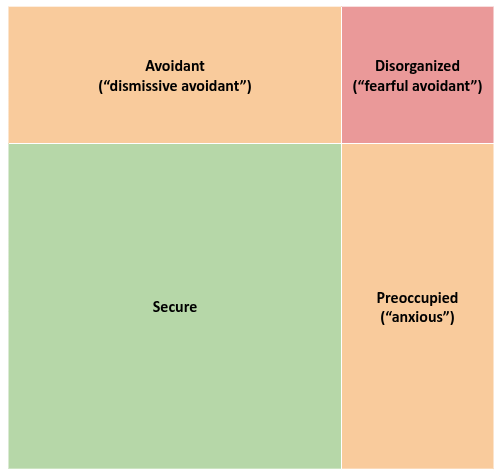
Our attachment styles – our early-life strategies for securing safety and connection – form a blueprint for our relationships throughout life. There are four primary styles:
Secure: A baseline of trust in others and a sense of self-worth. This fosters resilience and comfort with interdependence.
Preoccupied (alias anxious): A preoccupation with relationships and a fear of abandonment, often leading to a desire for validation from others.
Avoidant (alias dismissive-avoidant): A prioritization of independence and self-reliance, often at the expense of emotional intimacy, stemming from a core belief that depending on others is unsafe.
Disorganized (alias fearful-avoidant): Resulting from experiences where a caregiver is a source of both comfort and fear, this style involves a painful mix of wanting and fearing closeness. It creates significant internal conflict and a powerful need for control to manage this chaos.
All attachment styles other than secure are also collectively referred to as insecure attachment.
This framework is not just for romantic relationships; it shapes our relationship to society, authority, and ourselves.
The Psychology of Followership
Dolores’s attachment style is highly avoidant and only mildly preoccupied. Avoidant attachment is very typical of NPD and ASPD, because arguably it’s a result of these disorders. Often the less disordered version of the person would have disorganized attachment or something close to it.
How does someone with these psychological adaptations gain a following – and why do democracies keep producing populations willing to hand one over?
The standard account, that charismatic leaders simply manipulate passive masses, misses half the equation. The appeal of an authoritarian leader is better understood as an interaction between the leader’s psychology and the collective attachment needs of the population. The following theory draws centrally on Otto Kernberg’s work on malignant narcissism and large group regression, integrates it with the dimensional attachment research pioneered by Brennan, Clark, and Shaver and Fraley, Waller, and Brennan, and tries to be specific about the psychological mechanism on the follower side.
The Substrate: A Population with Masked Insecurity
Most people are not particularly securely attached. They just look like it.
Attachment anxiety and attachment avoidance are continuous dimensions, not discrete categories. Taxometric analyses by Fraley and Waller and by Fraley and Spieker on infant data have consistently shown that there is no bright line dividing “secure” from “insecure” people – just a smooth, two-dimensional continuum. In a sample of over 22,000 adults, the population means on the ECR-R (a 1–7 scale where 4 is the midpoint) were 3.64 for anxiety and 2.93 for avoidance, with standard deviations of 1.33 and 1.18 respectively. The bulk of the population sits in a zone that is not robustly secure but also not clinically disordered. Meta-analyses of the Adult Attachment Interview put the rate of “secure” classifications at only about 50–56% in non-clinical samples – and that categorical cut imposes an artificial boundary on what is really a gradient.
Crucially, the two dimensions are moderately positively correlated (r = .41 in the Fraley sample). People who are somewhat anxious tend to also be somewhat avoidant. This means the population doesn’t cleanly sort into “preoccupied” and “avoidant” camps. A large portion sits in the mildly fearful-avoidant zone – harboring a degree of both the craving for closeness and the distrust of it that characterizes disorganized attachment at clinical levels.
There is also a measurement caveat that makes the picture even less reassuring. Fraley notes that the ECR-R “doesn’t assess ‘security’ with as much precision as ‘insecurity’” – item discrimination is lower at the secure end of both dimensions. Some people who score as mildly secure may actually be less secure than their scores suggest. The veneer may be even thinner than the numbers indicate.
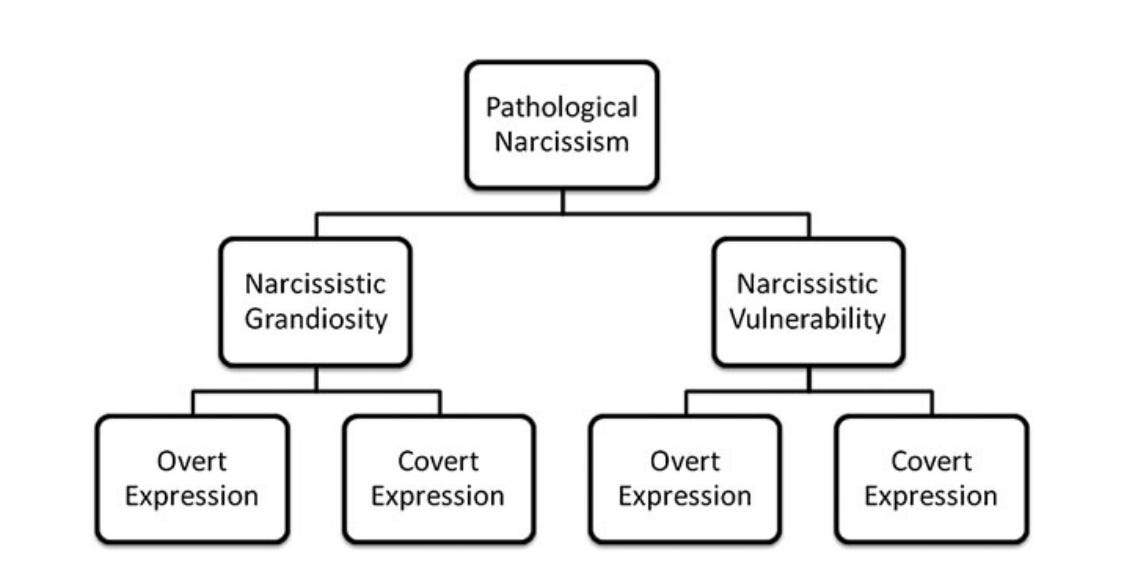
So what keeps all these mildly insecure people functioning? In Aaron Pincus’s taxonomy of pathological narcissism, the spectrum runs from overt grandiosity through covert vulnerability. I propose that most people manage their mild attachment insecurity by borrowing stability from external sources – their professional identity, social role, marriage, political tribe, or national narrative. This is a false-self defense: not the dramatic grandiose false self of NPD, but a subtler version in which the person’s sense of coherence depends on structures they don’t realize they depend on. They function well, and they feel secure – but the security is largely extrinsic, not intrinsic.
The Collapse: When the Borrowed Self Breaks Down
Then the status quo gets disrupted.
A financial crisis wipes out jobs and savings. A war displaces millions. A pandemic isolates people from their social roles. Traditional institutions lose legitimacy. The external structures that were doing the psychological work of maintaining identity and self-worth suddenly vanish.
This is the trigger that Kernberg describes in his 2020 paper and his earlier work on sanctioned social violence: When the normal social structures that assure individuals of their status disappear, the population undergoes what he calls “large group regression.” Drawing on Freud’s group psychology, Bion’s theory of basic assumptions, and Melanie Klein’s developmental positions, Kernberg argues that the population collectively “regresses” to what Klein called the paranoid-schizoid position – the primitive defensive mode characterized by splitting (the world divides into all-good and all-evil), denial, omnipotent control, and projective identification. I argue that this is less a regression of and more an unmasking of a fundamental borderline organization.
What does this look like psychologically? The mildly insecure majority – the people who were getting by with borrowed stability – lose the external validation that their fragile self-concept requires. They enter a state akin to what clinicians would recognize in individual patients as a mild, chronic narcissistic collapse. Their identity feels diffuse. Their world feels unpredictable and threatening. They can no longer answer the question “Who am I?” by pointing at their job title or their social role.
Vamik Volkan’s concept of “chosen trauma” – a shared mental representation of ancestral suffering transmitted across generations – adds a transgenerational dimension. During regression, the chosen trauma is reactivated to shore up the threatened group identity, fueling a sense of historical grievance that can be politically mobilized. This is the mechanism that connects the first step of my cycle (wars cause widespread trauma) to the susceptibility of later generations who didn’t directly experience the original trauma but carry its imprint in their group identity, the parenting practices they were exposed to, and the beliefs and behaviors that they perpetuate.
The Bond: Finding a New Self in the Leader
The regressed population is now desperate for what Kernberg calls a “second skin” – a new false self that restores a sense of security. This is where the preoccupied dimension of attachment becomes politically decisive.
Remember that the population mean on anxiety (3.64) is meaningfully closer to the scale midpoint than the mean on avoidance (2.93). The average person’s attachment system skews slightly more hyperactivating – oriented toward seeking closeness and external reassurance – than deactivating. When external identity structures collapse, the predominant pull is toward finding a new attachment figure, not toward power-seeking or withdrawing into isolation.
An authoritarian leader with Dolores’s avoidant-narcissistic profile slots perfectly into this vacancy. The leader provides two things the regressed population craves:
A borrowed identity. The leader offers strong, simple identification: “You are part of my movement. You are great because I am great.” Kernberg specifically notes that this identification “spares the need for the mass to envy the leader” – the population gets to participate in the leader’s grandiosity rather than measuring themselves against it. For people whose self-concept has just collapsed, this is profoundly relieving.
An ideology of splitting. The leader provides a framework that channels the population’s already-activated primitive defenses into political form: An ideology “that allows to identify the self against the other, aggressively othering a victim minority of choice.” The scapegoated minority absorbs the population’s projective identifications – all the weakness, shame, and vulnerability that the followers cannot tolerate in themselves gets located in the outgroup. To those with collective trauma, a leader who validates their sense of grievance provides a channel for their rage that can feel deeply empowering.
What makes this bond so resistant to correction is that it resembles a trauma bond more than a simple dependency. The leader’s intermittent appearances on television, unpredictable loyalty tests, and alternation between warmth toward loyalists and punishment of dissenters recreate the approach-avoidance dynamic of disorganized attachment. The follower can’t simply walk away (as a purely avoidant person might) but also can’t calmly evaluate the leader (as someone with less anxiety might). They’re stuck – not because they lack intelligence, but because the bond keeps them hooked like a drug.
This is a positive feedback loop: The regressed population selects the narcissistic leader, and the leader’s behavior reinforces the population’s regression. This is a key mechanism behind the cycle from my introduction – and it explains why the cycle is so hard to break without intervention at multiple points.
Kernberg discusses some of those intervention points. He identifies independent social structures – free media, independent judiciary, professional armed forces – as the primary buffers that can “set limits to the antisocial behaviors adopted by the leader, for example by not allowing dishonesty.” At the individual level, drawing on historian Timothy Snyder’s On Tyranny, he emphasizes “individual courage, responsibility, independence of thinking and public action” as qualities that permit a person to “stand up to the dangerous imprisonment in regressive group formations.” More on interventions in the next section.
Related perspectives
The theory above synthesizes several research traditions. Here is a brief tour, highlighting where each converges with and diverges from the account above.
Erich Fromm, Escape from Freedom (1941). Writing decades before Bowlby formalized attachment theory, Fromm argued that the “authoritarian character” is “extremely alone and gripped by a deeply rooted fear” and seeks “secondary bonds” – submission to authority – as substitutes for lost primary attachments. His analysis of Weimar Germany anticipates nearly every element of the model above: the destabilized population, the intolerable freedom, the flight into certainty. Fromm frames it in terms of existential freedom and social character rather than attachment dimensions, and he doesn’t distinguish the specific defense mechanisms (splitting, projective identification) that Kernberg adds from the Kleinian tradition.
Alexandra Stein, Terror, Love and Brainwashing (2nd ed., 2021). Stein – a cult survivor and researcher – uses attachment theory to explain how charismatic leaders create disorganized attachment in followers by being simultaneously the source of comfort and fear. She applies this framework across religious cults, political cults, terrorist organizations, and totalitarian states. Where I emphasize the pre-existing insecurity of the population as the substrate, Stein focuses on how even relatively secure individuals can be broken down by sustained exposure to the frightening-yet-caregiving dynamic. Both accounts are probably correct at different ends of the vulnerability spectrum: Pre-existing insecurity lowers the threshold, while sufficiently extreme environments can push almost anyone into disorganized attachment.
Antigonos Sochos, “Authoritarianism, trauma, and insecure bonds during the Greek economic crisis” (2018). Perhaps the clearest empirical snapshot of the cycle caught in the act. Using a large community sample during Greece’s economic catastrophe – 40%+ income loss, 56% youth unemployment, mental health spending halved, nearly 60% of participants reporting severe post-traumatic stress – Sochos found that authoritarianism was independently linked with insecure attachment in both person-to-person and person-to-state bonds, mediated by post-traumatic stress and perceived loss of social cohesion. Golden Dawn’s concurrent rise from fringe group to 7% of the national vote provides the political outcome. This study captures the collapse and the bond in a single dataset; it doesn’t address the substrate of pre-existing insecurity, but the severity of the crisis likely overwhelmed false-self defenses across the board.
Omri Gillath and Joshua Hart, “The effects of psychological security and insecurity on political attitudes and leadership preferences” (2009); Mikulincer and Shaver, “Boosting Attachment Security to Promote Mental Health, Prosocial Values, and Inter-Group Tolerance” (2007). Experimental work showing that providing people with an alternative source of psychological security – even just subliminally priming the secure-base schema – reduces endorsement of anxiety-driven political attitudes and hostility toward outgroups. This is the complement to Sochos’s correlational findings: If insecurity drives authoritarian attitudes, then boosting security should reduce them – and it does. These studies directly support the intervention logic in the next section.
Christopher Weber and Christopher M. Federico, “Interpersonal Attachment and Patterns of Ideological Belief” (Political Psychology, 2007). Maps attachment dimensions directly onto political ideology, finding that attachment anxiety predicts preferences for social order and certainty. This is consistent with my emphasis on the preoccupied dimension as the primary driver of susceptibility: It’s the anxiety dimension, not avoidance, that predicts the longing for certainty that authoritarian leaders promise to satisfy.
Kleppestø et al., “Attachment and Political Personality are Heritable and Distinct Systems” (Behavior Genetics, 2024). An important counterpoint. This large Norwegian twin study (N = 1,987) found that attachment and political personality (right-wing authoritarianism, social dominance orientation) are both heritable but show “no shared environmental overlap.” This challenges a simple developmental-pathway account where bad parenting causes insecure attachment which causes authoritarian attitudes. My model is compatible with this finding: It doesn’t require that insecure attachment causes authoritarian ideology, only that insecure attachment – whatever its origins – creates the psychological readiness to bond with an authoritarian leader when external structures collapse. Someone can carry both heritable traits independently and still have the second amplify the political expression of the first under stress.
Breaking the Cycle
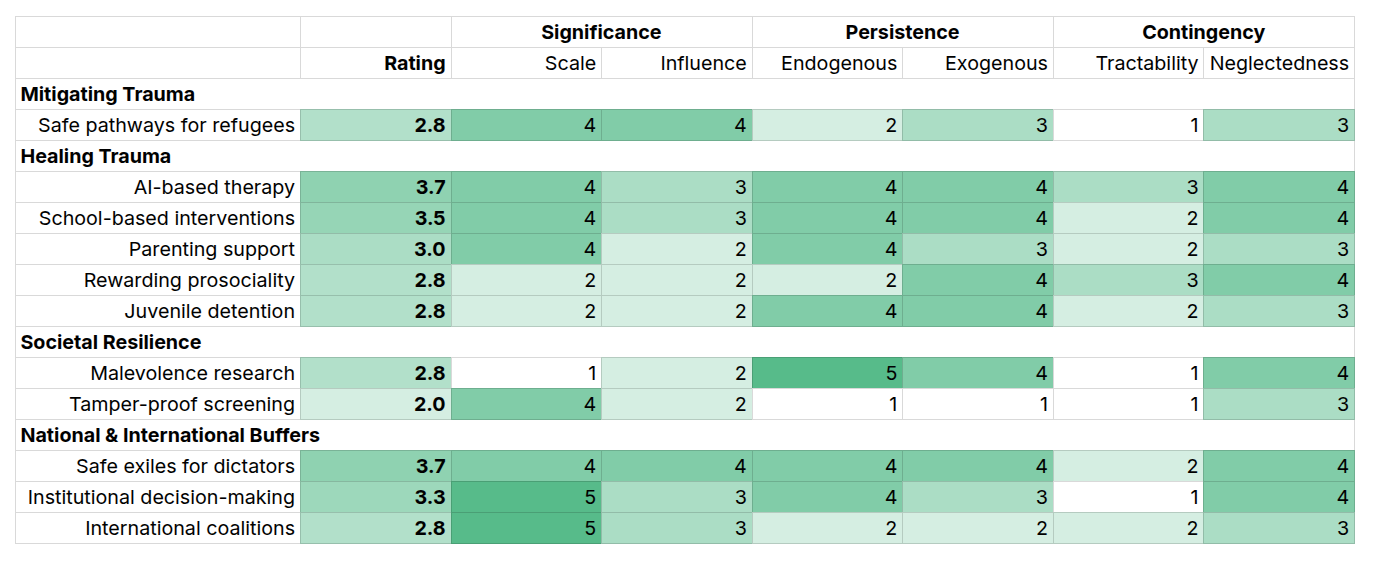
Breaking this pernicious cycle requires a multi-layered strategy, acting on individuals, institutions, and our foundational knowledge. The following combines the developmental approach of this article with several institutional and long-term proposals from David Althaus and Tobias Baumann’s work. I’ve added to each strategy areas of expertise that are likely required to pull them off.
In general, we want to optimize for something like Aaron Antonovsky’s “Sense of Coherence,” a measure of good mental health:
Comprehensibility. The belief that the world around you is structured, predictable, and makes sense. Events aren’t random and chaotic; they are explainable.
Manageability. The belief that you have the resources (either your own, or available from your family, friends, or community) to meet the demands of life. The feeling that “I can handle this.”
Meaningfulness. The belief that life’s challenges are worthy of investment and engagement. This is the motivational component – the feeling that it’s worth it to try.
I’ve tried to guess very roughly where, on a scale from 1 to 5, I see each intervention area. I’ve broken this down first according to the significance-persistence-contingency framework and second according to my own subdivisions.
My intuition is that AI-based therapy, school-based interventions (merged for simplicity), safe exits for dictators, and improved institutional decision-making are the greatest levers. But not by a great margin. Opportunism and personal fit will likely make the decisive differences.
Mitigating Trauma
Safe pathways for refugees. Currently it’s an often deadly and tremendously traumatic affair to try to emigrate from a country that is at war. The UN Refugee Agency and others advocate for safe and regulated pathways for refugees.
Politics, policy, activism
Healing Trauma
Parenting classes. If we intervene in high schools and teach state-of-the-art practices of good parenting, we can break cycles where children learn harmful practices from their parents and pass them down. Even adolescents who will continue to suffer from personality disorders that tend to be passed down can force themselves to treat their children better than their intuitions would have them.
Policy, schoolbook publishing, pedagogy, psychology
Mental health classes. Good mental health practices are often learned, and that learning could happen in school rather than in the therapy sessions of only those who seek therapy.
Policy, schoolbook publishing, pedagogy, psychology
Values classes. Compassion, rationality, assertiveness, and radical acceptance are key to the recovery from NPD and ASPD. Furthermore, NPD is sustained by self-deceptions that are at odds with rationality and sometimes compassion, so these values can make it easier for sufferers to recognize their self-deceptions.
Policy, schoolbook publishing, pedagogy, psychology
AI-based therapy. Mental health classes may be both too hard to establish and not sufficiently focused on the individual. But perhaps the rollout of individual AI-based therapy for every pupil is more realistic and focused. AI-based therapy can also offer a non-judgmental first step for individuals who, like Dolores, may not trust human therapists. “The Kauai Study” found that a strong bond in childhood with at least one mentally healthy adult is critical for the mental health of the child, and perhaps an AI can provide this bond for children who know no mentally healthy humans.
Psychology, software engineering, policy
Parenting support. Policies that reduce parental stress – such as paid parental leave, affordable childcare, and home-visiting nurse programs – interrupt the transmission of trauma and foster secure attachment.
Psychology, policy
Juvenile detention. Many people who’ve recovered from ASPD say that prison sentences (sometimes several) have been invaluable for them and that they wish they had been caught and gone to prison earlier than they did. In this way, juvenile detention is perhaps an effective de facto therapy of ASPD that can intervene early in a person’s life. Ideally the criminal record should expire to not limit the person when they’re trying to turn a new page.
Policy, politics
Rewarding prosociality. People with NPD can have a highly prosocial self-image that motivates them to change the world for the better. They often lack an internal feedback mechanism that rewards them when they’re doing a good job, making them dependent on external feedback. Stronger norms to publicly and frequently reward prosocial behaviors could have an even greater positive effect on people with NPD than on the average person.
Philanthropy, activism
Societal Resilience
Secure attachment. As described above, a populace with largely secure attachment is less likely to be receptive to disordered messaging.
See previous section
Sense of coherence. As described above, a populace with robust mental health and resilience.
See previous section
Egalitarian social norms. Authoritarian leaders will ring false to the ears of a populace that values flat hierarchies.
Unclear
Malevolence research. Althaus & Baumann call for a focused research program to develop better constructs and measures for the traits that cause the most harm. A deeper understanding of the neurological and psychological underpinnings is a prerequisite for effective interventions.
Psychology
Tamper-proof screening. A key proposal from their work is the creation of reliable, manipulation-proof measures of malevolence. These could one day be used to screen for high-risk individuals in positions of immense power, such as heads of government or leaders of critical global institutions.
Psychology, policy
National and International Buffers
Better institutional decision-making. As Althaus and Baumann note, classic political science solutions are a vital complement to psychological ones. This includes strengthening democratic checks and balances, promoting measures to reduce political polarization, and supporting a well-resourced, independent press.
Policy, politics, activism, journalism, law, sociology, economics
International coalitions. Elegantly constructed international coalitions and contracts can increase the stability of the whole worldwide system.
Policy, politics, activism, law, sociology, economics
Safe exiles for dictators. Some dictators want to retire at some point but can’t because they need the power of the state to prevent attempts on their lives. Providing them with a way in which they can cede power without being killed may increase the chances that they’ll negotiate a transition of power.
Military, politics, policy
Risks
Lack of psychopathy. People with secure attachment and without any personality pathology can still be zealously righteous about whatever tribal moral goals they subscribe to. That’s also a risk factor. People with pure psychopathy may in fact be unusually immune to that, thereby unlocking gains from moral trade.
Naïveté. Maybe peace is better kept and more stable by maintaining a balance of highly manipulative and power hungry people on all sides, the same way some people argue that nuclear war is better prevented by maintaining a balance of sufficiently large well-maintained nuclear arsenals in the hands of many countries around the world.
Discrimination. Some measures risk exacerbating the discrimination against perfectly prosocial people suffering from personality disorders.
A Call to Action
Talk to me if you have access to any of the relevant fields, and maybe we can strategize.
Do you know any organizations that are working on this?
Protect yourself but also be patient with people with personality disorders. They can heal and use their skills for prosocial ends.